
Introduction
A U-bolt is a U-shaped fastener with two threaded legs. It clamps pipes, tubes, springs, and frames against a plate or bracket on vehicle suspensions, exhaust systems, piping runs, farm equipment, and industrial assemblies.
The wrong one fails slowly or all at once. It has to hold clamping force through load, vibration, movement, heat, and weather. A loose or mismatched U-bolt lets parts wear, shift, or separate.
This guide compares U-bolts by shape, material, finish, strength, and application. It then covers how to measure and specify the right one.
Key Takeaways
- Shape, material, grade, finish, and dimensions must all match the application.
- Round, square, semi-round, flat, double, and custom bends suit different component geometries.
- Order by thread, inside width, inside length, leg length, bend radius, and thread length, not nominal size.
- Pick grade and finish for the environment and OEM requirements, not for maximum strength.
What Is a U-Bolt and Why Is It Important?
What Is a U-Bolt?
A U-bolt is a bent metal fastener whose curved crown wraps a component. The threaded legs pass through a plate, bracket, or frame. Nuts and washers then create the clamping force.
U-bolts fall into two broad groups. General-purpose types hold pipe or tubing. Application-specific designs serve leaf-spring suspensions, exhaust systems, structural assemblies, and heavy machinery, where the axle, plate, and clearances dictate the shape.
ASME's bent bolt standard, B18.31.5, covers inch-series U-bolt dimensions, including Vee-bend variants.
Why Is a U-Bolt Important?
The right U-bolt keeps a part attached and aligned while sharing load. It also controls vibration. Skip proper selection or torque, and documented failure modes include:
- Lost clamp force, letting parts move and wear inside the clamp group
- Improper torque, which Hendrickson warns can cause component damage and loss of vehicle control
- Fatigue under cyclic loading, even when static loads look safe
- Corrosion, especially where dissimilar metals meet in moisture
- Cracks from forming bends that are too tight
Suspension, chassis, exhaust, and pressure piping jobs each have their own torque, inspection, and replacement rules. Follow the OEM or manufacturer instructions for yours.
Types of U-Bolts
U-bolts can be classified several ways: by bend shape, by material or finish, or by the job they do. The categories overlap, so a single part might be a square-bend, zinc-plated, Grade 8 U-bolt for a trailer.
Type 1: Shape- and Configuration-Based U-Bolts
Shape names are not universally standardized. Always confirm with a drawing.
| Shape | Typical use | Watch for |
|---|---|---|
| Round | Pipe, tube, shafts | Specify inside width and radius |
| Square | Square or rectangular tubing, beams, frames | Corners may still be radiused |
| Semi-round | Leaf-spring suspension | Get the profile drawing |
| Flat/coined | Flattened crown spreads force over more area | A contact treatment, not always a separate shape |
| Double | Crossing pipes or purlins at right angles (one supplier's definition) | Supplier-specific |
| V-shaped/custom | Unusual geometry, engineered assemblies | Specify crown geometry and mating section |
A poor fit concentrates stress. A round bend on a square tube leaves little contact and lets the part shift. A square bend on a pipe does the same in reverse.
Bend radius matters too. Portland Bolt suggests a square-bend radius of at least twice the bar diameter. Tighter bends may need hot bending, and heating high-strength steel can require heat treatment afterward.
Type 2: Material, Finish, and Strength-Based U-Bolts
Material, finish, and grade are three separate decisions.
- Plain or alloy steel: Suits dry service and high strength, but needs corrosion protection outdoors.
- Zinc-plated: Electroplated per ASTM B633 at 5, 8, 12, or 25 micrometers. Spec F1941/F1941M; "zinc plated" alone is not enough.
- Hot-dip galvanized: ASTM A153 Class C calls for a minimum 2.1 mils average on fasteners over 3/8 in. It is thicker, so check thread fit.
- Stainless steel: Suits moisture, marine, chemical, and washdown settings. Portland Bolt quotes 304 and 316 properties at 75 ksi min. tensile, below Grade 8; threads can gall.
Grade 5 versus Grade 8. Under SAE J429, Grade 5 (1/4 through 1 in.) has a 120 ksi minimum tensile and 85 ksi proof. Grade 8 has 150 ksi and 120 ksi. Those are material properties, not assembly ratings. A finished U-bolt's capacity depends on geometry, load direction, and temperature.

High-strength steel and plating need care. B633 warns against electroplating steels above 1700 MPa because of hydrogen embrittlement.
Type 3: Application-Specific and Heavy-Duty U-Bolts
These types group by what they secure.
- Suspension: Clamp leaf springs to axles. Hendrickson's HAS procedure specifies hardware, lubricant, torque (425 ± 25 ft-lb for 7/8-14 UNF), and retorque at 1,000 miles.
- Exhaust: Walker lists T-304 stainless U-clamps with an 11-gauge saddle. Pipe diameter, heat, vibration, and serviceability drive the choice.
- Piping: Support or guide lines where thermal expansion, insulation clearance, and backing saddles matter. ASC's Fig. 137 lists a 1/2-in. pipe unit at 580 lb normal load at 650°F; stainless ratings run 0.85 times the listed values.
- Agricultural, trailer, and industrial: Shock, mud, chemicals, and tight spaces often call for heavy-duty or custom dimensions.
Custom U-bolts give a precise fit. The trade-off is drawings, dimension checks, possible tooling, longer lead times, and technical review.
Ottawa Products Co. makes custom bent bolts, including U-bolts, V-bolts, and J-bolts, in thread sizes from 1/4″ through 1/2″. Its guillotine and double-edge clamps use U-bolt designs for heavy-duty exhaust work.
How to Choose the Right Type of U-Bolt
Selection is a fit-and-performance decision. Work through it in order.
- Define the application. Pipe, exhaust, leaf spring, frame, trailer part, or machine component?
- Assess conditions. Static and dynamic loads, shock, temperature, thermal expansion, chemicals, moisture, and maintenance access. Get load ratings from the manufacturer.
- Measure, don't guess. Nominal size is not enough.
- Choose material, finish, and grade together. Compare corrosion resistance, strength, temperature limits, galvanic compatibility, and cost.
- Verify documents. Check drawings, OEM specs, and supplier paperwork before ordering.

Key Measurements
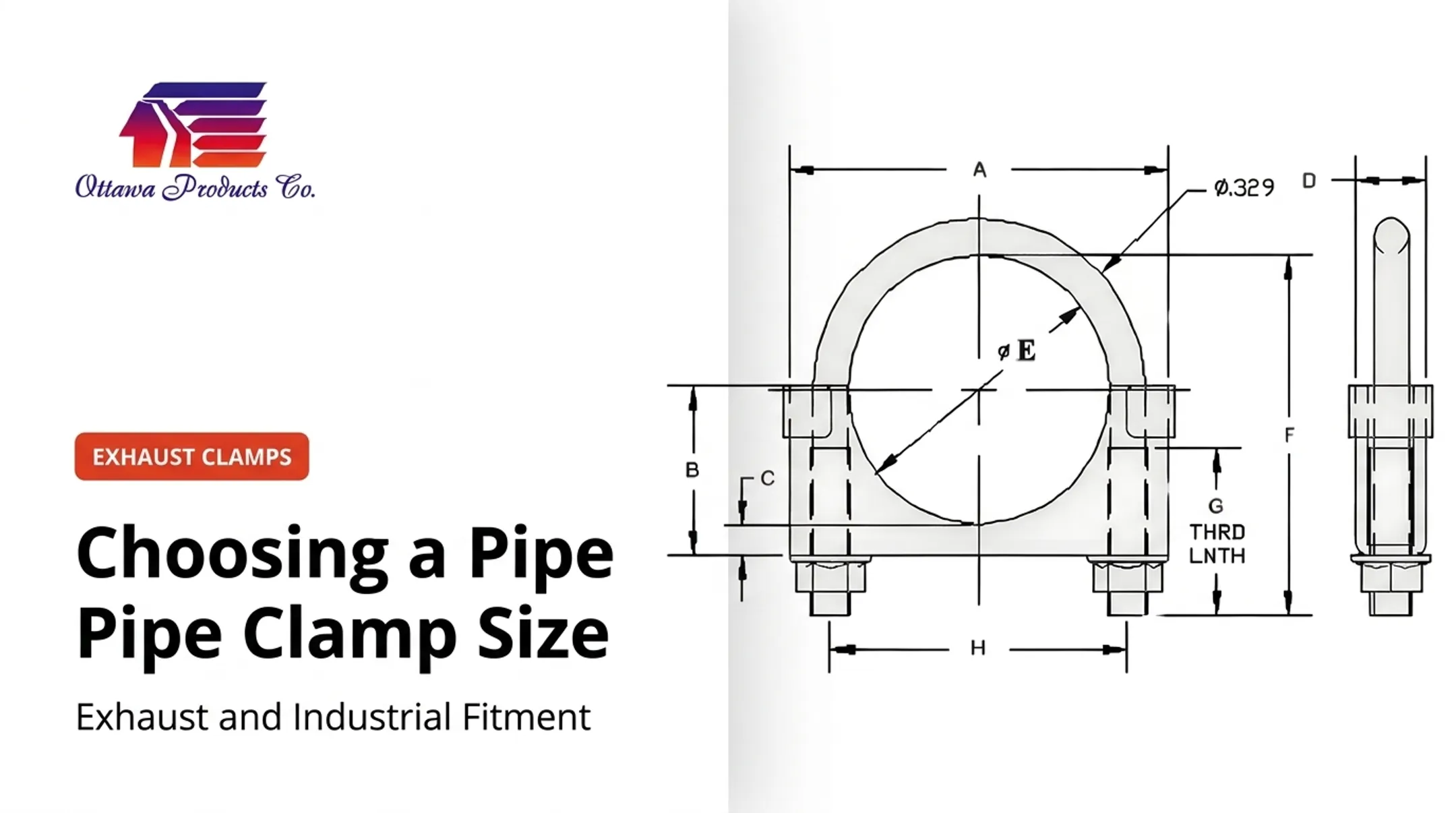
- Thread: Diameter and pitch. Inch examples: 5/8-11 UNC versus 5/8-18 UNF. Metric threads need diameter and pitch under ISO 262.
- Inside width: Clear spacing between legs. State whether you mean clear or centerline.
- Inside length: Measured from the inside of the bend to the leg ends, not overall height.
- Leg and thread length: Thread length runs to the last full-form thread.
- Bend radius: The inside radius.
- Plate stack: Thickness of plates, saddles, washers, or brackets.
Keep nuts, washers, and mating hardware in the same thread system. Ottawa's drawings use a D × L × C × T dimension set in inches.
Supplier Qualification
For OEM exhaust, agricultural, or industrial parts needing a custom bent component, Ottawa Products Co.'s quoting and engineering teams are a resource. The company manufactures in Curtice, Ohio, under an ISO 9001:2015-certified quality system, with certifications and PPAPs available.
ISO 9001 certifies a management system, not a particular U-bolt's load capacity. Ask for part-level documentation such as PPAP as well.
What to Check Before Finalising a U-Bolt Type
What to Check Before Finalizing a U-Bolt Type
- Confirm against the drawing or OEM spec. Don't copy an old U-bolt that is bent, stretched, or corroded.
- Skip the "best" by default. The highest grade, thickest stock, or toughest finish may not fit the plate, clearance, torque, or thread engagement.
- Match the hardware. Hendrickson specifies Grade C locknuts, hardened washers, and full seating without gaps.
- Follow the procedure. Lubricant, tightening pattern, stages, and rechecks come from the OEM. Freightliner specifies diagonal tightening.
- Plan inspection. Look for movement, fretting, worn components, loosening, and cracks.
Reuse depends on the application. Hendrickson's HAS instructions require discarding U-bolts and fasteners on the side being serviced.
Replace safety-critical suspension and chassis U-bolts per service guidance. Don't modify them or reuse them without approval.

Conclusion
U-bolts provide clamping and mounting support across automotive, heavy-duty, agricultural, piping, construction, and industrial work. Shape, material, finish, grade, application, and dimensions all affect performance, so no single type fits every installation.
Verify measurements and specifications with an OEM, engineer, or qualified supplier before ordering. This matters most for dynamic-load, suspension, chassis, and custom applications.
Frequently Asked Questions
What are the different types of U-bolts?
By shape: round, square, semi-round, flat, double, V-shaped, and custom. They also vary by material, finish, and application. The right one depends on fit and operating conditions.
What is the difference between Grade 8 and Grade 5 U-bolts?
Grade 8 has higher minimum tensile (150 ksi versus 120 ksi) and proof strength under SAE J429. Verify the U-bolt standard, manufacturer rating, and geometry before substituting.
What are the different sizes of U-bolts?
Size includes thread diameter and pitch, inside width, inside length, leg length, thread length, bend radius, and metric or inch threading. Nominal diameter alone can't identify a replacement.
How do I measure a U-bolt correctly?
Measure thread diameter and standard, inside width, inside length, leg length, thread length, and bend radius. Use an undamaged reference part or the equipment drawing.
Can a U-bolt be reused after installation?
It depends on the application and manufacturer instructions. Inspect for stretching, thread damage, corrosion, cracks, or deformation. Replace suspension and chassis U-bolts per OEM guidance.