
Introduction
Anchor bolt diameter and length define how a connection transfers load, how it fits, and how long it lasts. Get either wrong and you face rework at best, a failed connection at worst.
Diameter alone won't pick the bolt. Loads, base material, embedment, grade, spacing, edge distance, thread details, and anchoring method all matter. Even the same nominal 1/2-inch size can carry different hole sizes across five common anchor types.
This guide gives you a nominal diameter chart (U.S. customary and metric), explains how to read it, and walks through verifying a specification before you buy or install anything.
Key Takeaways
- Diameter is the nominal outside diameter of the threaded shank, not length, pitch, or hole size.
- No universal minimum size exists; loads, substrate, grade, and geometry decide.
- Treat the chart as a reference, then confirm manufacturer data and project drawings.
- Metric and inch sizes are not interchangeable by approximate conversion.
What Anchor Bolt Size and Diameter Represent in Structural Applications
Anchor bolt diameter is the nominal outside diameter of the threaded or load-carrying shank. It is separate from overall length, threaded length, hook or head dimensions, and nut size.
Diameter sets the steel cross-section, and that drives potential tension and shear resistance. But the steel doesn't always fail first. Concrete, masonry, base plate, washer, and connection geometry can govern before the bolt does.
Size is a design choice made from the required load path. Capacity is a result, and it depends on grade, embedment, concrete condition, spacing, edge distance, and failure mode.
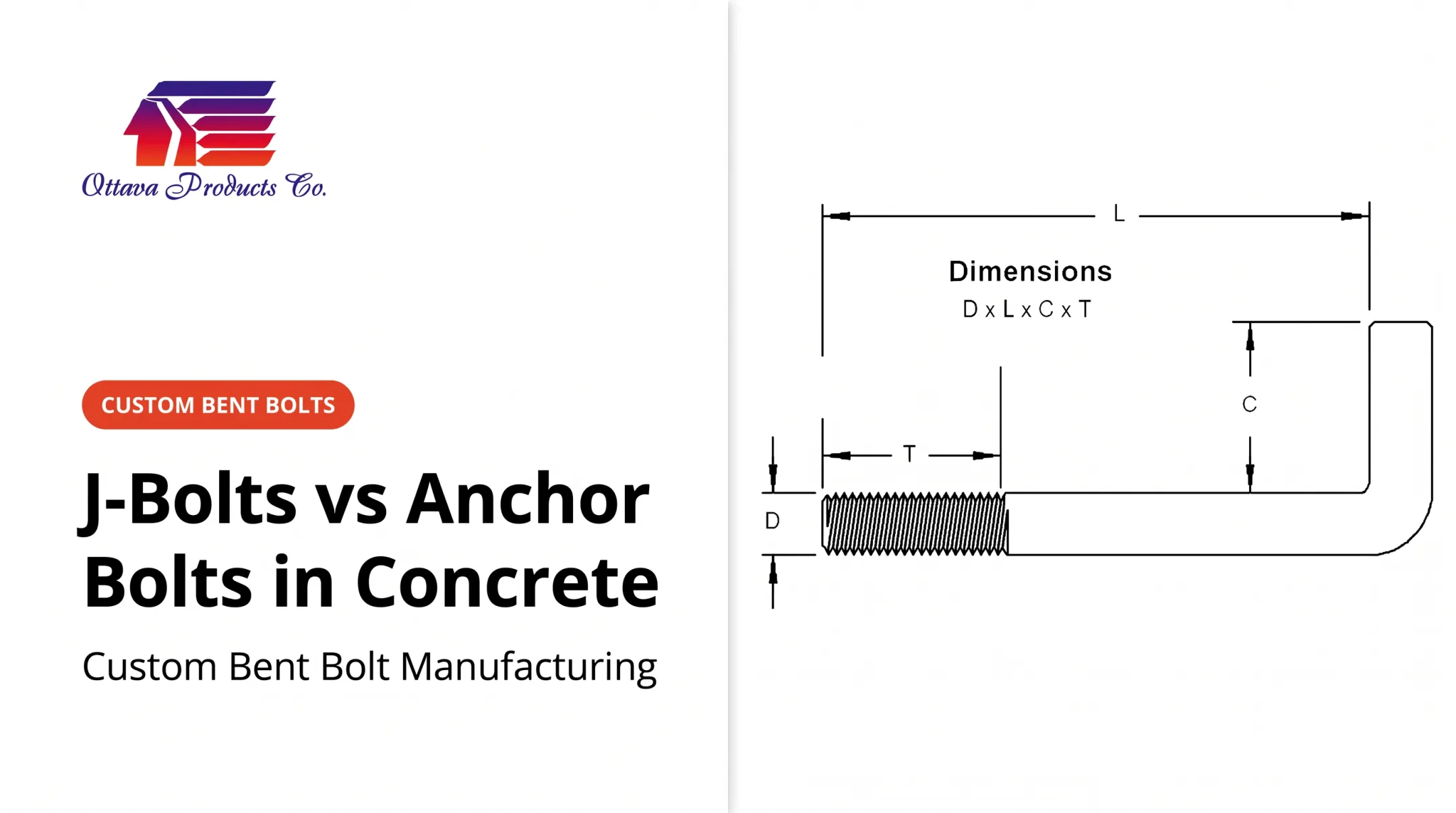
Ottawa Products Co.'s custom bent bolt drawings reflect this separation: they identify diameter, overall length, and threaded length as distinct dimensions.
Factors That Influence Anchor Bolt Size in Real-World Applications
Theoretical capacity and field performance differ. Common reasons:
- Concrete cracking
- Placement and installation tolerances
- Corrosion and damaged threads
- Inconsistent torque or curing conditions
AISC's 2025 guidance allows a horizontal placement variation of +/-1/4 in. for 3/4- and 7/8-in. rods and +/-1/2 in. for top elevation. Real bolts rarely land exactly where drawn.

Design conditions also shape the required size:
- Tension, shear, and bending
- Vibration, impact, uplift, and dynamic loading
- Base material strength
- Moisture or corrosive exposure
ACI 318-19 Chapter 17 lists failure modes to check:
- Tension: steel yield or fracture, concrete breakout, pullout, side-face blowout, and bond failure
- Shear: steel failure, breakout, and pryout
Always cite the governing code, ASTM specification, or manufacturer data rather than a generic load value.
Anchor Bolt Size and Diameter Chart
This chart lists nominal dimensions only. Do not use it as a sizing tool. Verify every value against the current standard and manufacturer documentation.
Anchor Bolt Diameter Reference
U.S. customary (ASTM F1554-20 coarse thread, UNC)
| Nominal diameter, in. | Threads per inch | Nominal diameter, in. | Threads per inch |
|---|---|---|---|
| 1/2 | 13 | 1-3/4 | 5 |
| 5/8 | 11 | 2 | 4.5 |
| 3/4 | 10 | 2-1/4 | 4.5 |
| 7/8 | 9 | 2-1/2 | 4 |
| 1 | 8 | 2-3/4 | 4 |
| 1-1/8 | 7 | 3 | 4 |
| 1-1/4 | 7 | 3-1/4 | 4 |
| 1-1/2 | 6 | 3-1/2 | 4 |
F1554-20 covers 1/2 to 4 in. for grades 36 and 55, and 1/2 to 3 in. for grade 105. Smaller 1/4-in. products fall outside its scope. Uncoated threads default to Class 2A.
Metric (ISO coarse and selected fine pitch)
| Nominal size | Major diameter, mm | Coarse pitch, mm | Selected fine pitch, mm |
|---|---|---|---|
| M12 | 12 | 1.75 | 1.25 |
| M16 | 16 | 2.0 | 1.5 |
| M20 | 20 | 2.5 | 1.5 |
| M24 | 24 | 3.0 | 2.0 |
| M30 | 30 | 3.5 | 2.0 |
| M36 | 36 | 4.0 | 3.0 |
Fine pitches shown are not exhaustive. Metric pitch is the distance between adjacent threads; inch threads use TPI.
Conversion caution: TR Fastenings states that nearest-equivalent thread sizes are not directly interchangeable because of thread geometry and pitch differences. Don't swap an M16 for a 5/8-inch bolt because the diameters look close.
What the chart doesn't show: length, threaded length, bend or head configuration, washer requirements, and required embedment. Each is a separate field on any complete specification.
For example, Portland Bolt lists bent anchors in diameter x length x hook x thread-length order. Length is measured from the inside bend to the threaded end, not as an embedment depth.
Chart by Anchor Bolt Type and Application
Cast-in anchor bolts (headed, bent, straight, headless) are specified differently from post-installed anchors such as wedge, sleeve, drop-in, adhesive, and concrete screws. F1554-20 covers the cast-in forms and excludes mechanical expansion anchors.
Bolt diameter charts are not drill-bit charts. Hole size doesn't always equal nominal size. These product-specific examples show the range:
| Type | Nominal size, in. | Specified hole, in. | What "nominal" means |
|---|---|---|---|
| Wedge (Simpson Strong-Bolt 2) | 1/2 | 1/2 | Anchor diameter |
| Sleeve (DeWalt Power-Bolt) | 1/2 | 1/2 | Assembly size; internal bolt is 3/8-16 UNC |
| Drop-in (DeWalt Steel Drop-in) | 1/2 | 5/8 | Internal thread size, 1/2-13 UNC |
| Adhesive (Simpson SET-3G) | 1/2 rod | 9/16 | Threaded rod diameter |
| Concrete screw (Simpson Titen HD) | 1/2 | 1/2 | Nominal anchor size |
These are examples, not rules for each anchor family. Use the exact installation chart for the model you selected.
Interpreting Nominal Size, Grade, and Capacity
The same nominal diameter performs differently depending on grade, material, coating, thread condition, embedment, concrete strength, and installation quality.
| F1554-20 grade | Minimum yield, ksi | Tensile range, ksi | Diameter range, in. |
|---|---|---|---|
| 36 | 36 | 58-80 | 1/2-4 |
| 55 | 55 | 75-95 | 1/2-4 |
| 105 | 105 | 125-150 | 1/2-3 |
These are steel properties, not installed capacities. Concrete failure checks are separate.
- Weldability: Supplementary requirement S1 restricts grade 55 chemistry. Without it, grade 55 may or may not be weldable.
- Galvanizing: F1554-20 points to ASTM F2329 for hot-dip coatings. Coated thread length is an order field.
- Metric classes: ISO 898-1 classes 4.6, 8.8, and 10.9 carry nominal tensile values of 400, 800, and 1,000 MPa. Class 10.9 minimums are 1,040 MPa tensile and 940 MPa proof stress.
- Related specs: ASTM A307 Grade A has a 60 ksi minimum tensile and no specified minimum yield. ASTM F3125 covers structural connection bolts, not anchors.

No single capacity number fits every case. Capacity depends on design assumptions that belong in an engineered calculation.
How to Select, Specify, Measure, and Validate Anchor Bolt Size
Anchor bolt selection is a specification and verification process. Start with project drawings, equipment documentation, or an engineer's requirements rather than field measurement alone.
Start With the Application and Design Loads
Gather this before choosing a diameter:
- Supported structure or equipment
- Tension, shear, overturning, and uplift loads
- Vibration, impact, seismic, or wind exposure
- Number of bolts and bolt pattern
- Expected service life
Then assess the base material:
- Concrete strength
- Cracked versus uncracked condition
- Masonry type
- Reinforcement conflicts
- Available embedment depth
Confirm Geometry, Embedment, Spacing, and Edge Distance
Verify these geometry details:
- Bolt length and effective embedment
- Exposed thread, plate thickness, and washer/nut stack-up
- Spacing, edge distance, and clearance below the anchor
Effective embedment is not total bolt length. Use the anchor manufacturer's installation requirements, not a universal depth formula.
Specify Grade, Material, Thread, and Finish
Specify each of the following:
- ASTM or other standard and strength grade
- Steel or stainless material
- Thread series and pitch
- Finish, plus nut and washer compatibility
- Weldability where relevant
Galvanizing affects thread fit. The American Galvanizers Association notes that nuts are tapped oversize after galvanizing to accommodate coated male threads. Specify replacement nuts and bolts as a matched system.
Measure Existing Anchor Bolts Correctly
- Clean the exposed threads.
- Measure across the outside thread crests with calipers on a full thread.
- Identify pitch with a pitch gauge (TPI for inch, millimeters for metric).
- Record usable exposed length.
- Photograph the bolt pattern and surrounding base.

Avoid these measurement mistakes:
- Measuring the nut instead of the bolt
- Estimating size from a photo
- Measuring a damaged or tapered thread end
- Assuming a nearby common size fits
Validate Before Ordering or Installing
Confirm each item:
- Nominal diameter, length, and thread pitch
- Grade, material, and finish
- Anchor type and quantity
- Bolt pattern and embedment
- Substrate and installation method
- Manufacturer or engineer approval
For safety-critical connections, have a qualified engineer review selection and replacement.
Custom Bent Bolt Requirements
Some jobs need a formed fastener rather than a standard straight anchor bolt. Ottawa Products Co. is a U.S.-based manufacturer of custom bent bolts and related components, made in Curtice, Ohio, under an ISO 9001:2015-certified quality management system. Its listed anchor bolts run from 1/4 inch through 1/2 inch.
Its quote request uses separate fields for diameter and thread pitch, length, bend dimensions, threaded length, material, coating, and quantity. For custom geometry or OEM formed-fastener needs, confirm dimensions and application details with the engineering or quoting team. Ottawa Products supplies the formed part; it does not provide structural design approval for the anchor connection.
Implications of Incorrect Anchor Bolt Sizing or Installation
A wrong diameter or specification can cause:
- Insufficient preload or bolt yielding
- Pullout, concrete breakout, or cracking
- Thread incompatibility
- Inability to reach required embedment
The 2006 Boston Big Dig ceiling collapse shows what a specification failure costs. The NTSB found that design and approval failed to account for poor epoxy creep resistance, and adhesive anchors pulled free under sustained load. One person died. It was an adhesive specification failure, not a wrong-diameter case.
Common Misinterpretations of Anchor Bolt Size
- Nominal diameter as a full spec: Length, grade, pitch, finish, anchor type, and geometry must also be identified.
- Diameter confused with hole size: Drill-bit diameter, hole diameter, nut dimensions, and embedment are different measurements.
- Bigger as automatically safer: A larger bolt can reduce edge distance and spacing margins, overload the base material, and fail to fit the washer or access space.
Performance, Safety, and Compliance Consequences
Errors lead to installation delays, rework, equipment instability, and noncompliance with project documents.
Under the 2024 IBC Section 1705.3, cast-in anchors get periodic special inspection. Some product evaluation reports, such as ESR-4057 for Simpson SET-3G, require continuous inspection for sustained-tension adhesive anchors. Warranty and inspection problems follow when records don't match what was installed.
Conclusion
Diameter is a governing specification, but reliable performance comes from the full combination: diameter, length, grade, thread, embedment, substrate, geometry, and installation method.
Use the chart as a starting point. Engineering requirements, manufacturer instructions, applicable standards, and field measurements control the final selection.
Frequently Asked Questions
How do I know what size anchor bolts to buy?
Start with the application loads, substrate, and anchor type, then specify diameter, length, grade, embedment, thread, and finish. Confirm everything against project drawings or manufacturer data.
What are the standard sizes of anchor bolts?
Anchor bolts come in many U.S. customary and metric diameters and lengths. "Standard" depends on the anchor type, application, and governing specification.
What is the minimum size for anchor bolts?
No single minimum applies to every case. Load requirements, substrate, anchor system, code, and engineering design set it.
What are the 10 types of anchor bolts?
Cast-in types include headed, bent (L- and J-shaped), straight, and headless bolts. Post-installed types include wedge, sleeve, drop-in, and adhesive anchors, plus concrete screws.
What is the size of an M16 bolt?
M16 means a 16 mm nominal diameter, with a 2.0 mm coarse pitch. The full specification also needs length, grade, material, and matching nut and washer.
What is the size of an M30 bolt?
M30 means a 30 mm nominal diameter, with a 3.5 mm coarse pitch. State thread, length, grade, finish, and application requirements when ordering or replacing.