
This guide is for OEM manufacturers, equipment builders, fabricators, distributors, repair operations, and engineers. It covers materials, bend geometry, forming methods, applications, limits, and sourcing.
One caution up front: field-bending is a poor fit for load-critical or code-regulated work. Professionally formed bent fasteners offer repeatable geometry and documented quality.
Key Takeaways
- Grade, diameter, thread, and forming process all depend on the application.
- Specify bend radius, thread integrity, load direction, and corrosion environment before production.
- A custom-manufactured bent rod is generally more consistent than a field-bent one.
- Never use bent all-thread as a structural anchor without engineering approval and code compliance.
What Are Stainless Steel Bent Threaded Rods?
What is a stainless steel threaded rod?
A threaded rod is a long fastener with external threads along all or part of its length. It works with nuts, washers, couplers, and brackets.
Portland Bolt describes all-thread as straight rod threaded along its entire length. That is a common manufacturer definition. ASME B18.31.3 is the dimensional reference for inch threaded rod.
Related product forms include:
- Continuous all-thread: threaded end to end
- Studs: continuous-thread or double-end parts threaded at the ends (ASME B18.31.2)
- Bent bolts: U-bolts, hook bolts, and J-bolts (ASME B18.31.5)
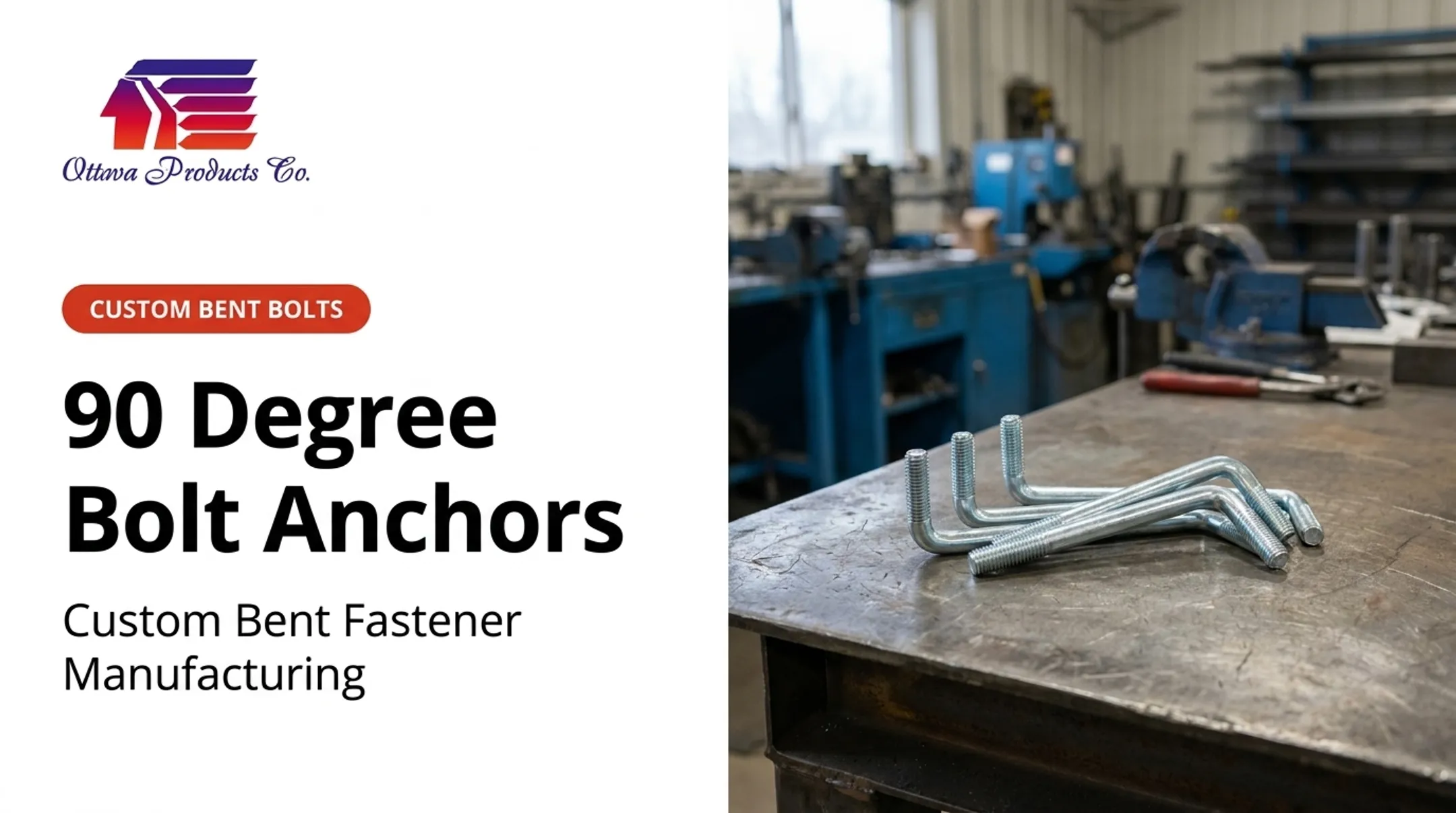
A bend creates U, J, V, or offset shapes while leaving threaded ends for attachment. Ottawa Products Co. lists U-bolts, hook bolts, V-bolts, and straight single- and double-end threaded stud bolts among its custom bent bolts.
Why choose stainless steel?
Stainless offers corrosion resistance, a clean appearance, and lower maintenance. That suits industrial, automotive, agricultural, and outdoor service.
304 and 316 are the common grades. Rolled Alloys notes that 316's molybdenum improves chloride pitting and crevice resistance, while the two have comparable formability. Neither is immune to corrosion.
Limits to plan for:
- Work hardening during forming
- Galling when nuts are installed
- Higher material cost than plain steel
- Not automatically right for every temperature, chemical, or load
Which specifications define the finished rod?
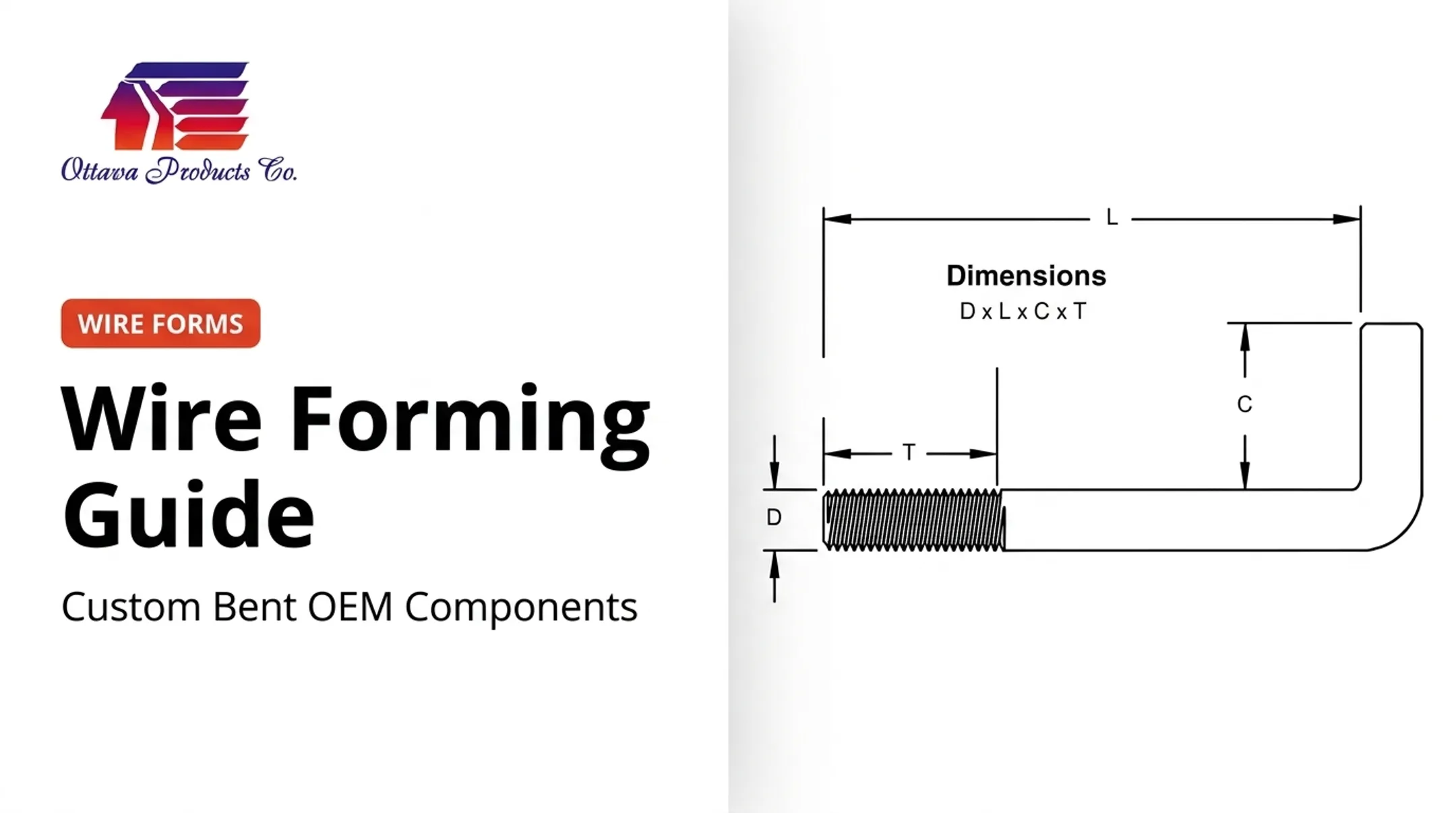
"Bent threaded rod" is not a specification. A dimensioned drawing is. It should state:
- Nominal diameter and thread series or pitch
- Overall length and leg lengths
- Bend angle, radius (inside or centerline), and tangent locations
- Usable thread length on each end
Ottawa's U-bolt drawings, for example, define diameter, overall length, inside width, and threaded length, and the V-bolt drawing adds the bend angle in degrees.
Where Bent Stainless Steel Threaded Rods Are Used
Bent rod fits wherever a threaded connection must follow a path or fit a tight space:
- Exhaust clamps and hangers
- Equipment mounting and custom brackets
- Pipe and conduit supports
- Guards and retaining hardware
Stainless versions show up in the field. Marsh Fasteners lists 304 and 316 U-bolts for marine, boat trailer, and exterior use, and Gibson specifies 316 U-bolts for conduit and pipe supports. Treat these as product examples, not structural qualifications.
Ottawa Products Co. supports heavy-duty truck, agricultural, high-performance automotive, off-road, and industrial markets. That does not mean every application in those markets uses stainless bent rod.
The line that matters is load. Positioning and retention hardware is one thing. Components carrying significant tension, shear, vibration, fatigue, uplift, or impact loads are another, and they need engineering review.
Material and Design Considerations for Bent Threaded Rods
Selecting the stainless steel grade
Weigh these factors against the application:
- Moisture, salt, and chemicals
- Exhaust conditions and temperature
- Strength and forming behavior
- Mating hardware compatibility
Use current supplier or standards data. Do not assume one grade is always more corrosion-resistant or easier to bend.
Condition matters as much as grade. Under ASTM A193, B8 and B8M Class 1 both carry minimum tensile and yield of 75/30 ksi, per Portland Bolt. Class 2 is stronger in smaller diameters. Those are material minimums, not allowable loads for a bent part.
Designing the bend
Tighter bends raise local strain, distort thread crests and roots, and create stress concentrations. Use the largest radius the assembly allows. Minimum bend radius for solid stainless rod varies by grade and diameter, so confirm limits with your manufacturer.
The drawing should identify:
- Bend angle and radius definition
- Tangent points and orientation
- Leg symmetry and tolerances
Expect springback, too. Austenitic stainless partly recovers its shape after tooling releases, more so as strength rises. Production tooling or a forming trial is often needed for repeatable dimensions.
Evaluating loads and failure risks
Account for these loads together:
- Tension, shear, and bending
- Vibration and fatigue
- Torque and combined loading
Threads reduce effective area; tensile stress area, not nominal diameter, governs. NASA's threaded-fastener standard requires considering tension, shear, and bending interaction together, and ties fatigue resistance to thread-root radius.

No universal capacity exists for a bent rod. Use engineering calculations, material allowables, or validation testing for the actual load.
Protecting threads and mating hardware
Flattened threads, galling, burrs, heat discoloration, and misalignment can block nut engagement or upset preload. Specify:
- Compatible nuts and washers
- Enough thread engagement
- Approved lubricant or anti-seize
Lubrication changes torque-tension behavior, so torque values must account for it.
Corrosion, heat, and surface condition
Forming, heat, tooling contamination, and post-processing can all affect the stainless surface. Cleaning, passivation, and finish should follow the grade, production method, and customer specification. Heat tint involves chromium-depleted layers, and the Nickel Institute notes passivation does not substitute for descaling. ASTM A380 covers cleaning and descaling; A967 covers passivation.
How Stainless Steel Threaded Rods Are Formed and Inspected
Choosing the forming process
Common options include:
- Cold forming
- Press or rotary bending
- Mandrel-supported forming
- Controlled hot forming
The right method depends on grade, diameter, radius, quantity, tolerance, and mechanical requirements. No universal heating temperature exists, and heat does not help every stainless application.
Preparing the rod and tooling
- Align the rod securely and apply force in a controlled way
- Use suitable dies and protect threads from clamping damage
- Support the rod so the bend lands where intended, without twist or flattening elsewhere
Cold-forming considerations
Austenitic stainless is ductile enough for cold forming, and cold work strengthens it. The tradeoffs are work hardening, springback, and cracking risk. Abrupt force, an undersized radius, or repeated reworking all hurt consistency. Qualify the process for each grade and geometry.
Hot-forming considerations
Heat can change dimensions, surface condition, properties, and corrosion behavior. IMOA flags carbide and secondary-phase risks, and low-carbon grades delay but do not eliminate sensitization. Follow grade-specific guidance and controlled procedures.
OSHA identifies stainless hot work as a possible hexavalent chromium source. Use ventilation, heat-resistant protective gear, safe handling, and the controls required by 29 CFR 1910.1026 where it applies.
Post-forming thread and surface treatment
Deburr, clean, and gauge threads after forming. Approved thread restoration may be needed, but chasing a thread cannot replace material lost to cracking or severe flattening. Passivate or otherwise treat the surface when forming has affected the finish.

Inspection and quality documentation
Check:
- Bend angle, radius, leg length, orientation, and overall length
- Thread gauge or nut fit
- Surface condition, plus visible cracking or flattening
For critical or high-volume parts, consider:
- First-article approval and process qualification
- Material identification and lot traceability
- Nondestructive or load validation where the design authority requires it Liquid penetrant testing (ASTM E1417) finds surface-connected flaws only.
A quality system such as Ottawa Products Co.'s ISO 9001:2015 certification supports controlled quoting, production, and inspection. It does not prove a given part suits a given load.
How to Specify and Source Custom Bent Threaded Rods
Specification checklist
- Stainless grade and condition
- Diameter, thread series, and pitch
- Overall length, leg lengths, and tangent locations
- Bend angle, radius, and tolerances
- Finish, quantity, and packaging
- Environment, expected loads, and required documentation
Send a drawing, sample, CAD file, or dimensioned sketch. Then ask the supplier how they control thread damage, bend repeatability, material traceability, inspection, and process changes.
Manufacturer versus hardware source
A general hardware source sells stock. A qualified custom fastener manufacturer holds geometry and documentation steady across runs, which matters for OEM, fleet, agricultural, industrial, and high-vibration work.
Working with Ottawa Products Co.
Ottawa Products Co. manufactures custom bent bolts at its Curtice, Ohio facility, including U-bolts, hook bolts, V-bolts, and threaded studs with downloadable drawings. It operates under an ISO 9001:2015 quality system, with quoting, engineering, quality, and shipping teams.

Send your drawing or application to the quoting team at quotes@ottawaproducts.com or 419.836.5111 and confirm stainless options before assuming availability.
Frequently Asked Questions
What is a threaded rod?
A threaded rod is a metal fastener with external threads, either full-length or partial. It pairs with nuts, washers, couplers, and brackets to join or hang components.
Can all thread be used for anchor bolts?
Not automatically. The 2024 IBC references ACI 318 for anchors, and ESR-4868 specifies straight, defect-free rods. A field-bent rod needs engineered design or a listed anchorage system.
Can an aluminum rod be bent?
Sometimes. It depends on alloy, temper, diameter, radius, and method. Aluminum behavior and strength should never be assumed to match stainless steel.