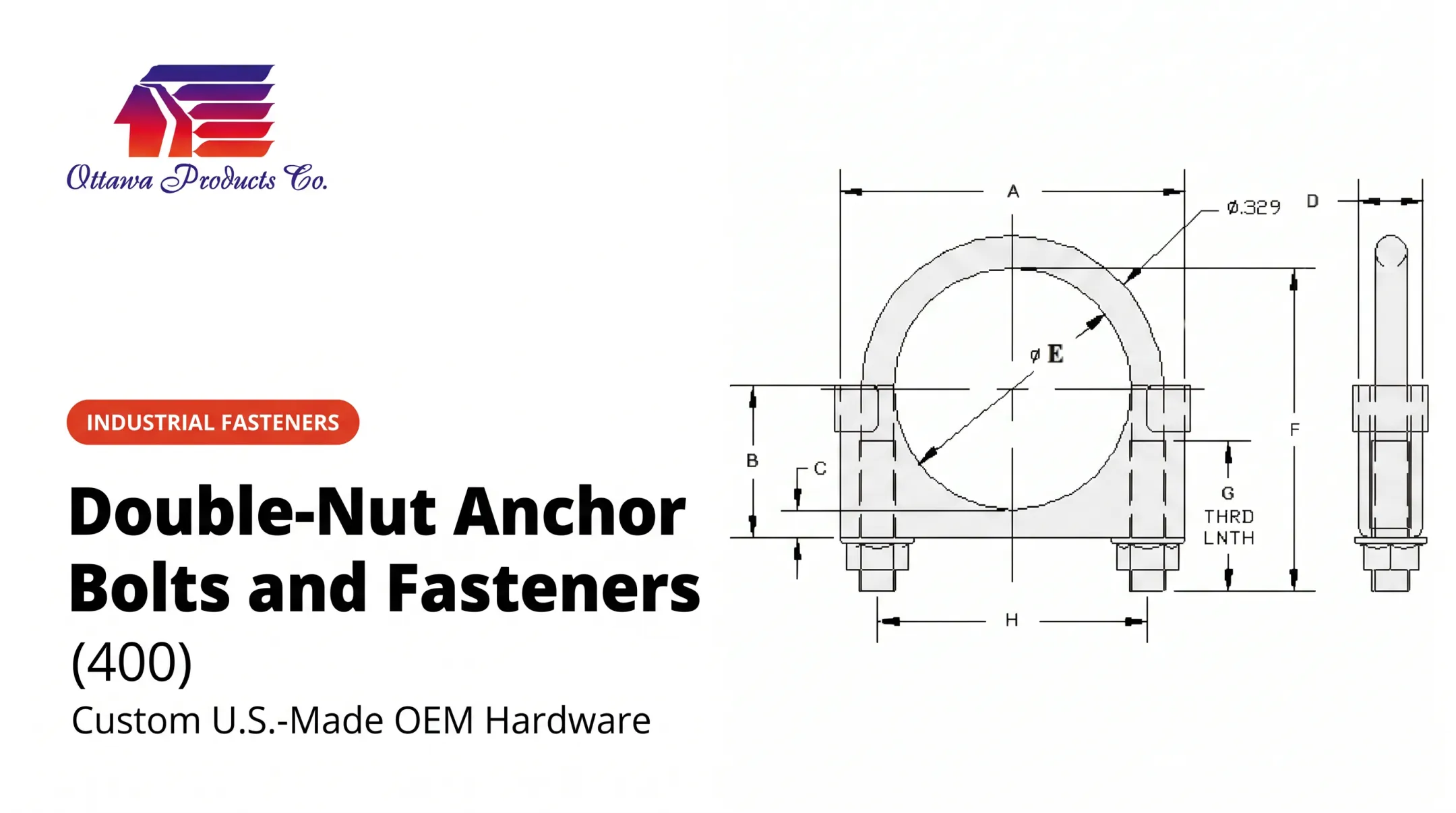

Introduction: Understanding 90-Degree Bolt Anchors
A 90-degree bolt anchor is a formed fastener with a threaded section and an anchoring section set at a right angle. It solves problems a straight bolt can't, such as tight layouts or a base that needs a hooked end to bear against.
This article covers industrial and OEM bolt anchors, not the 90-degree bolt throw on a rifle. It's written for design engineers, purchasing agents, fabricators, and distributors who select or source these parts.
Standards matter here. ASTM F1554-20 covers bent steel anchor bolts used to anchor structural supports to concrete. Below, we cover geometry, applications, specifications, manufacturing quality, and what to include in a quote request.
Key Takeaways
- "90-degree bolt anchor" covers L-bolts, bent bolts, hold-down bolts, and custom formed parts, so confirm the application first.
- Angle alone doesn't set strength; material, diameter, bend, embedment, and loading all count.
- Clear drawings and application details get you an accurate quote.
- Verify engineering requirements and standards before any load-bearing use.
What Is a 90-Degree Bolt Anchor?
A 90-degree bolt anchor is a fastener with one leg bent roughly perpendicular to the other, forming an L-shaped profile. STS Industrial describes the L-bolt as a headless fastener with a partially threaded shank. The unthreaded end bends 90 degrees and is cast in place to connect components to concrete.
How It Differs From Similar Parts
- J-bolt: Caltrans defines the hooked configuration with a 180-degree bend, versus the L-bolt's 90 degrees.
- Straight anchor or stud bolt: no bend, threaded at one end only.
- U-bolt: two threaded legs joined by a round or square bend.
- Rifle bolt throw: the bolt-handle lift on a firearm. Unrelated.
Names You'll Encounter
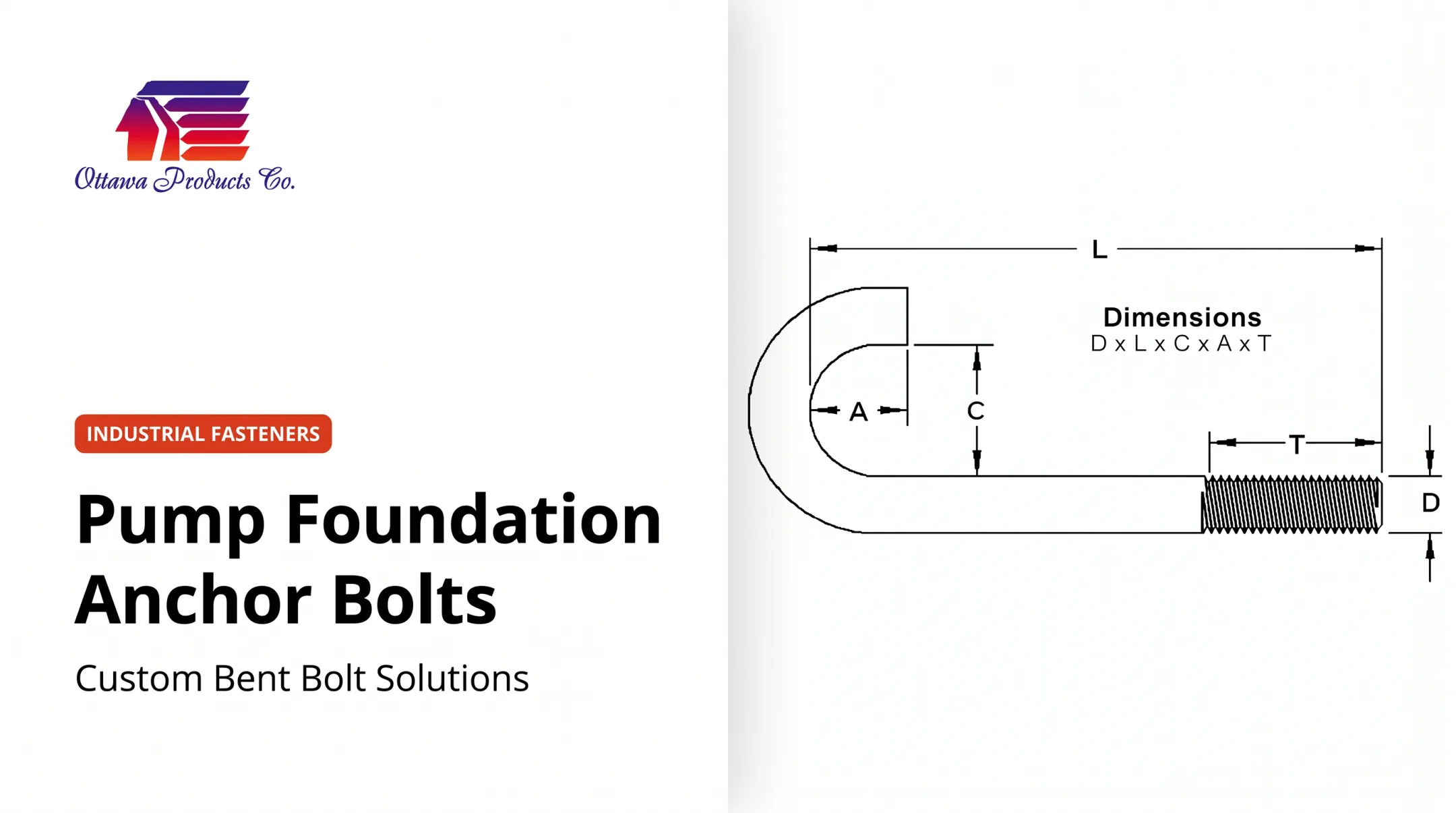
Naming varies by supplier and industry. Expect L-bolt, bent anchor bolt, right-angle bolt, hold-down bolt, formed bolt, and custom bent fastener. Ottawa Products Co. lists a "Hook Bolt, Right Angle Bend" with one threaded end and a 90-degree bend.
Parts to Identify on a Drawing
- Bolt diameter
- Thread size and length
- Straight-leg lengths
- Bend location and bend radius
- End treatment
- Any washer, plate, hook, or welded feature
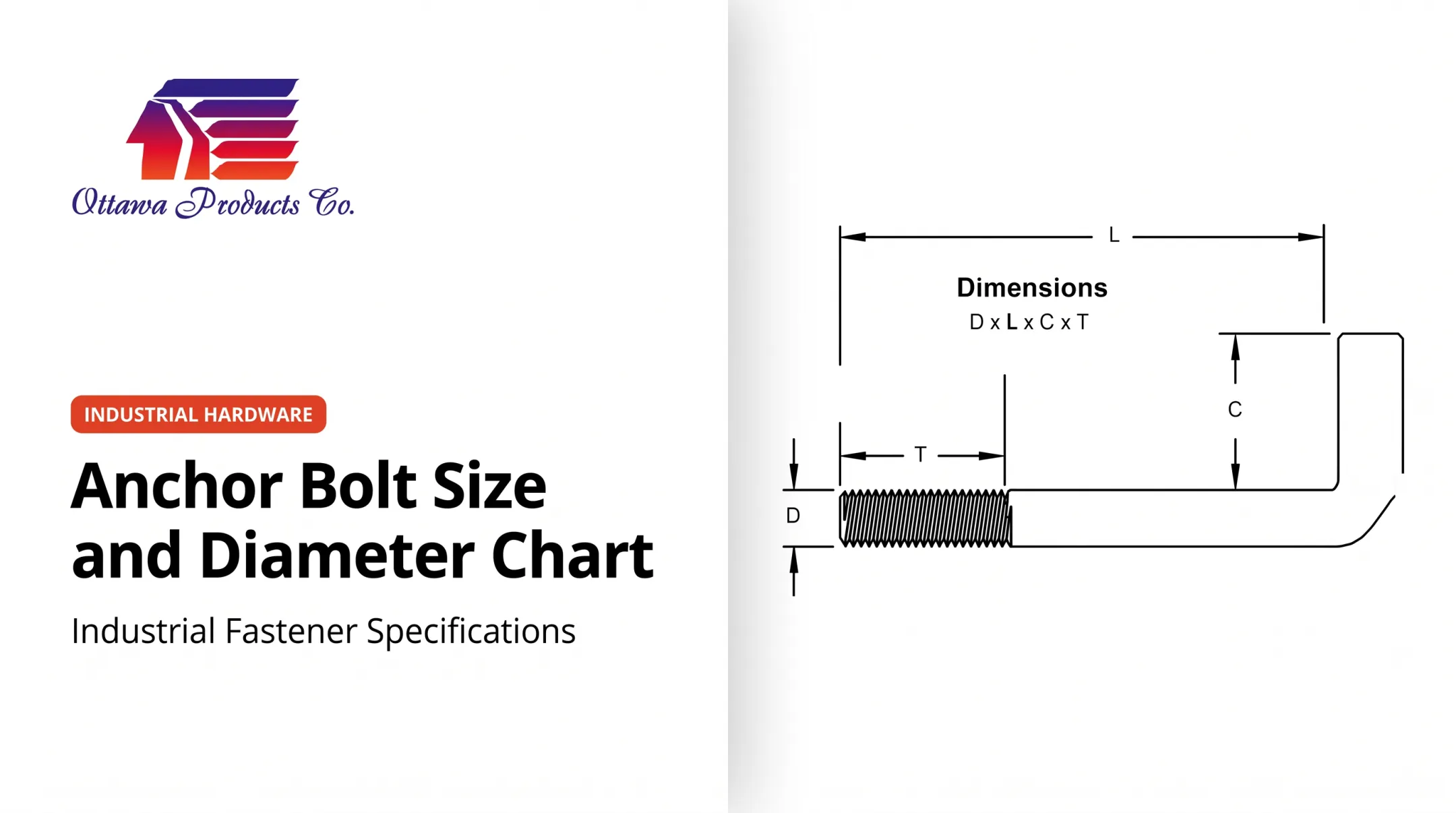
A labeled sketch showing the bend, threaded section, and anchoring section removes most ambiguity.

How 90-Degree Bolt Anchors Work and Where They Are Used
The threaded portion secures or clamps a component, and the bent portion transfers force into a base, bracket, frame, casting, or concrete. Caltrans notes hooked anchors hold mainly through bearing of the embedded bend against concrete.
Typical Applications
- Equipment bases and machinery frames
- Structural supports, light poles, and signs
- Agricultural and construction equipment
- Trailer and vehicle assemblies
- Industrial fixtures and OEM components
Ottawa Products manufactures custom bent bolts for heavy-duty truck, agricultural, high-performance automotive, industrial, and exhaust-system mounting.
Why Choose a 90-Degree Configuration
- Fits limited installation space
- Aligns with a base or bracket
- Clears adjacent parts
- Keeps threads accessible from one direction
Limitations
Watch for these common issues:
- Misalignment during install
- Short thread engagement
- Stress concentration at the bend
- Interference with nearby parts
- Installation in an unintended orientation
AISC does not recommend hooked rods where column-base uplift or moment resistance is required.
Safety note: Confirm design loads, base material, embedment or engagement requirements, tightening procedures, and applicable codes with a qualified engineer or installer. Don't assume a load rating without verified data.
Key Specifications for Selecting a 90-Degree Bolt Anchor
Drawing Checklist
- Nominal diameter, thread type, and pitch
- Threaded and unthreaded length
- Both leg lengths
- Bend location and bend radius
- Dimensional tolerances
Ottawa's right-angle hook-bolt drawing defines the part by D × L × C × T, with standard tolerances of .XX ±0.060, .XXX ±0.030, and fractional ±1/32. Threads follow ASME B1.1 for inch series (UNC, UNF) or ISO 965-1 for metric. Unless specified, F1554 defaults to Class 2A coarse threads.
Material
Match material to the conditions the anchor will see in service:
- Strength, impact, and vibration
- Temperature extremes
- Moisture, chemicals, and dissimilar-metal contact
F1554 grades 36, 55, and 105 indicate minimum yield strength in ksi, not installed capacity. Grade 55 weldability requires supplementary requirement S1. Other options, such as A307, SAE J429 Grades 5 and 8, and stainless F593, are not F1554 equivalents.
Bend Geometry
Bend radius is agreed between buyer and manufacturer rather than fixed by one universal dimension, per ASME guidance. Under F1554-20:
- Bent portions must be crack-free at 10x magnification
- The bend must keep at least 90% of straight-section area
- Hook angle tolerance is ±5 degrees
Heat treatment may occur before or after bending or threading, so state your sequence if it matters.
Finish
Hot-dip zinc follows ASTM F2329. Electrodeposited coatings follow ASTM F1941, which addresses hydrogen-embrittlement precautions for high-strength fasteners. Confirm the finish suits the base material, environment, and any welding.
Surrounding Assembly
Account for these fit-up details before you order:
- Hole diameter and clearance
- Washer or plate needs
- Base thickness
- Tool access and installation order
Documentation
Specify the records you need with the order:
- Proof or tensile testing
- Dimensional inspection
- Material certifications and coating verification
- Traceability and any OEM standard
F1554-20 test reports include heat number, tensile results, lot number, and PO number.
Manufacturing and Quality Considerations
A custom bent anchor typically involves material preparation, forming, thread protection, bend control, secondary operations, finishing, and final inspection. Confirm which of these steps a given supplier handles in-house.

Before quoting, an experienced manufacturer should review:
- Manufacturability and bend radius
- Tolerances and tooling access
- Repeatability and production volume
- Packaging requirements
Ottawa Products Co. as a Resource
Ottawa Products Co. is a U.S.-based manufacturer in Curtice, Ohio, offering custom bent bolts and wire forms with engineering and quoting support. Its product line is diversified across OEM markets. Anchor bolts are listed from 1/4-inch C1541 through 1/2-inch mild steel, with coatings per customer requirements and no minimum order requirements.
Its quality system is ISO 9001:2015 certified (covering heavy-duty clamps and bent bolts), and certifications and PPAPs are available. ISO has published ISO 9001:2026 as the replacement edition. Confirm whether a specific 90-degree anchor is a standard item or built to your print before assuming availability.
How to Source or Request a Custom Bolt Anchor
A clear RFQ cuts delays on custom 90 degree bolt anchors. Gather the details below before you contact a manufacturer, then compare how each supplier responds.
RFQ Checklist
- Detailed drawing or sample
- Material and finish
- Thread specification
- Leg lengths and bend radius
- Tolerances
- Expected loads and operating environment
- Annual or batch quantities
- Inspection and documentation requirements
- Delivery expectations
Map those items to the supplier’s intake form. Ottawa’s bent-bolt request form asks for bolt type, D (thread pitch), L, C, A, T, B, material, coating, and quantity.
Evaluating Supplier Responses
When quotes come back, compare:
- Dimensional capability and forming consistency
- Quality documentation
- Engineering communication
- Production capacity and packaging
- Support for prototype and production runs
Contact Ottawa Products Co.
If you need a bent-bolt or anchor fastener, send the application details to quotes@ottawaproducts.com or engineering@ottawaproducts.com, or fax the Quotation Department at (419) 836-5111. The team will confirm capability fit and prepare an accurate quote. Prices can usually be emailed within 24 hours.

Frequently Asked Questions
What is a 90 degree bolt throw?
It commonly describes the rotation of a rifle bolt handle. A 90-degree bolt anchor is an industrial bent or right-angle fastener.
What does a 90 degree angle look like?
Two legs meet perpendicularly, like the corner of a square. In an L-shaped bolt anchor, the threaded leg and anchoring leg form that corner.
What is a 90-degree bolt anchor used for?
Hold-down, alignment, mounting, and OEM or industrial fastening. The exact use depends on component design and engineered load requirements.
How do I specify a 90-degree bolt anchor?
List material, diameter, thread, leg lengths, bend radius, tolerances, finish, application loads, environment, and required documentation.
Can 90-degree bolt anchors be custom manufactured?
Many bent fasteners can be made to a drawing or sample. The supplier must confirm material, tooling, tolerances, volume, and application requirements.