
Introduction
Custom automotive metal stamping turns sheet, strip, or blanks into repeatable parts built for one specific vehicle, exhaust system, or piece of equipment. A press closes a die, and the metal is cut or shaped to the same geometry every time.
Buyers struggle with consistent geometry, strength, fit, corrosion and heat resistance, cost control, and steady production without quality slipping.
Grand View Research puts 2025 U.S. automotive metal-stamping revenue at $11,963.8 million. That figure covers the broad market, not just brackets and clamps.
This guide covers the stamping process, applications, cost factors, supplier selection, and what to send with a quote request.
Key Takeaways
- Custom stamping relies on part-specific tooling built around your drawings, material, and volume.
- The workflow runs from requirements and design review to sample approval and controlled production.
- Tooling, material, tolerances, volume, finishing, and packaging all drive cost.
- Judge suppliers on engineering support, quality controls, and communication, not price alone.
What Is Custom Automotive Metal Stamping?
Custom Stamping Versus Standard Metal Components
Custom stamping uses presses, dies, and forming operations to make parts to your specifications instead of picking an off-the-shelf component. The press supplies force, and the dies cut or shape the sheet.
It differs from other metalworking processes:
- Machining removes material with tools such as lathes and mills.
- Casting pours molten metal into molds.
- General fabrication is an umbrella category that can include stamping.
Stamping stands apart for repeatable, die-based cutting and forming of a defined geometry.
Automotive Stamping Operations
A project may use one operation or several in sequence:
- Blanking cuts the outside perimeter.
- Piercing makes holes or slots.
- Trimming removes excess material from a formed part.
- Bending creates angles.
- Forming turns flat sheet into a three-dimensional shape.
- Drawing pulls material into a cavity.
- Embossing raises or depresses shallow features.
- Coining compresses metal into a profile.
The tooling is called a die. It works with a punch (the male element), and guide pins keep the die set aligned.
Why Automotive Manufacturers Use Stamping
Stamping supports consistent dimensions and repeat production for brackets, retainers, mounting components, shields, clamps, and hangers. One example: Perfection Spring & Stamping describes stamped brackets that mount or retain sensors, wiring harnesses, and fuel-system components, made in progressive dies.
Process selection depends on geometry, material behavior, required strength, installation method, volume, and fit with the assembly.
How the Automotive Stamping Process Works
Requirements Review and Design for Manufacturability
A supplier needs the following to start:
- 2D drawings and 3D CAD files
- Material grade and thickness
- Tolerances and bend requirements
- Surface requirements
- Annual volume and order quantities
- The intended application
Engineering review then looks for trouble spots: tight bend radii, holes too close to bends, difficult draw depths, and features that add scrap or tooling complexity.
WorldAutoSteel notes that higher-strength material generally needs a larger bend radius. Holes near bends can distort, and the safe distance depends on hole size, thickness, and radius. There is no universal rule.

Tooling and Die Development
Engineers use the approved design to plan the blank, material flow, feed direction, forming sequence, clearances, and die layout. The die approach then depends on the part:
| Die type | How it works | Trade-off |
|---|---|---|
| Progressive | Strip advances through successive stations | Higher build cost, higher production rate |
| Transfer | Separate blanks move between stations | Hard to justify at low volume |
| Compound | Blanking and piercing in one stroke | Best for mostly flat parts |
| Single-operation | One operation per stroke | Suits simple shapes and small runs |
No die type wins every time. Volume, geometry, and press capacity should be settled before tooling is quoted.
Pressing and Forming the Part
Sheet, strip, or blanks feed into the press and settle into position. The die applies force, then the part advances to the next operation or inspection.
Successive stations cut, pierce, bend, draw, trim, or form features until the finished geometry appears. The press and die arrangement depends on part size, material, thickness, geometry, volume, and required forming force.
Inspection and Production Control
Sample inspection, dimensional checks, visual inspection, and process monitoring confirm the part matches the approved design. First-article inspection checks initial parts against the drawing, including hole locations, bend height, and bend angle.
PPAP goes further. Under the AIAG PPAP manual, approval rests on a production run using the actual site, tooling, gaging, process, and materials. Specify which approval package you need.
Ottawa Products Co. operates an ISO 9001:2015 quality management system certified by NSF-ISR, and certifications and PPAPs are available. ISO 9001 is a general quality standard. IATF 16949 adds automotive requirements and is a separate certification, so confirm which one your program calls for.
Materials, Parts, and Automotive Applications
Selecting Materials for Automotive Stampings
Material choice balances strength, ductility, springback, corrosion resistance, heat exposure, vibration, weight, finish, and joining method. Common options:
- Carbon steel: grades range from commercial to extra-deep-drawing, so specify grade and condition.
- Stainless 409: a ferritic grade used in exhaust applications.
- Stainless 304: austenitic, with good formability and corrosion resistance.
- Aluminized steel: hot-dip aluminum-silicon coating, used for exhaust and heat shields.
- Aluminum: workable and corrosion resistant, but it springs back more than similarly strong steel.
Ottawa Products uses aluminized steel and 430 bright stainless in its AccuSeal Series, along with C1008, C1010, C1018, and C1541 carbon steel components in other series. Confirm aluminum or other alloys before quoting if your design needs them.
Automotive Parts Made Through Custom Stamping
Parts group naturally by function:
- Brackets and mounting plates
- Retainers and clips
- Shields and covers
- Structural or underbody components
- Seat and interior hardware
- Exhaust-system supports
Two parts that look alike may need different materials, thickness, forming sequences, or finishes. It depends on whether the part carries load, controls vibration, protects nearby components, or ties into an exhaust assembly.
Requirements for Exhaust and Heavy-Duty Applications
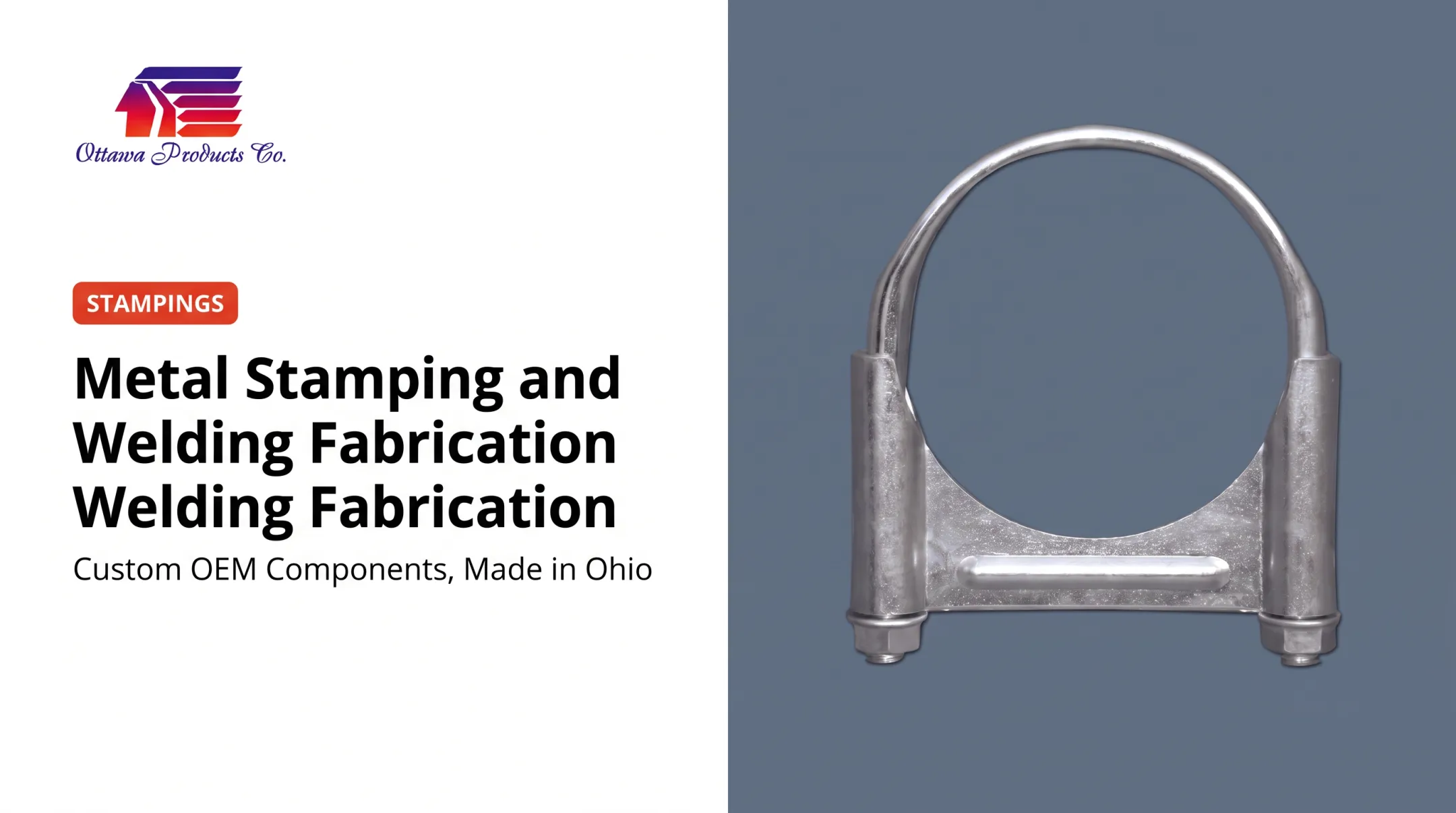
Clamps, hangers, and bent bolts face heat, thermal cycling, corrosion, and vibration. SAE research identifies cyclic engine loads and road loads as fatigue inputs for exhaust hangers. Fit around the pipe, load transfer, serviceability, and repeatable installation matter as well.
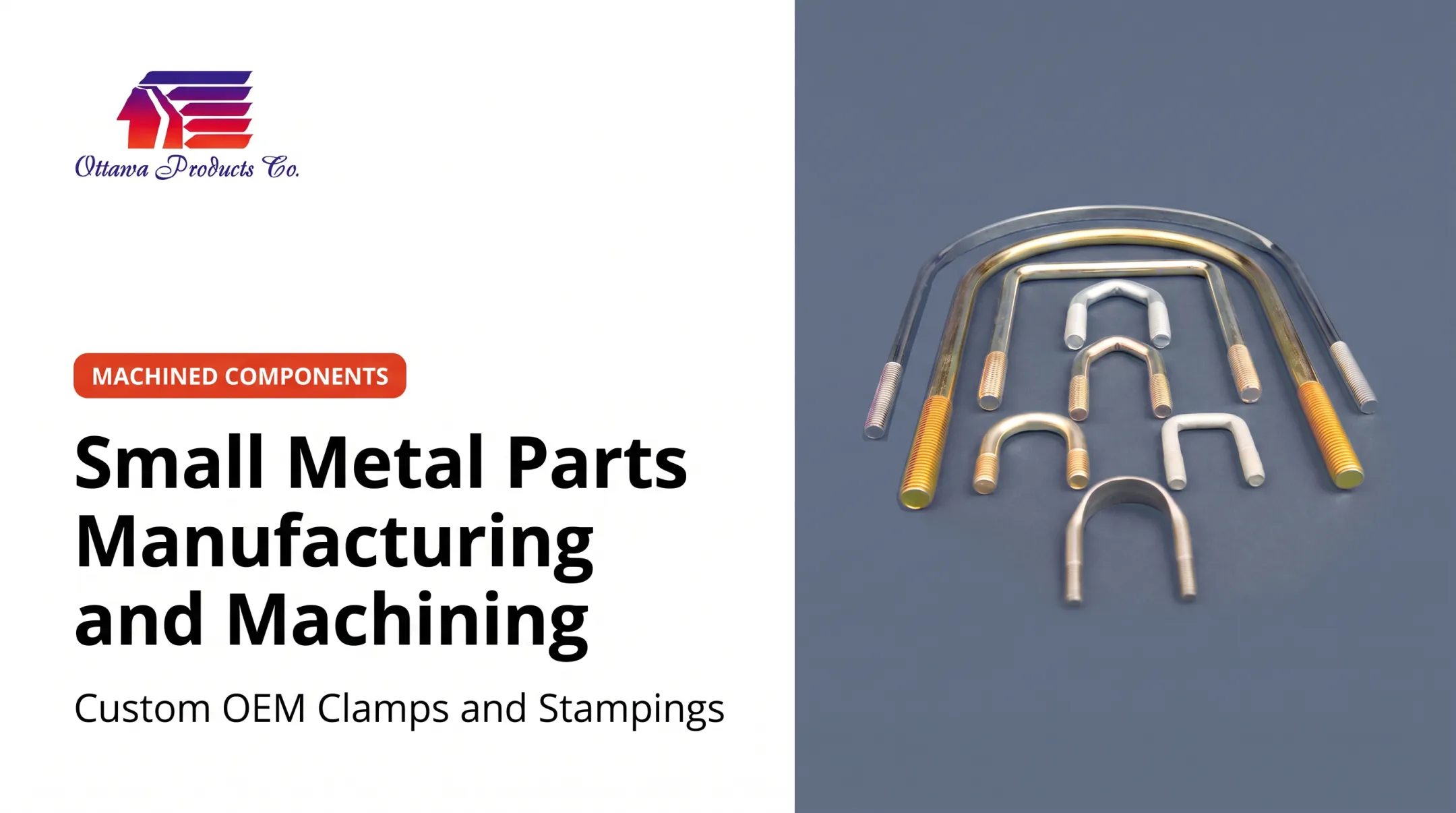
General automotive stamping often centers on body work. Ottawa Products focuses on OEM exhaust clamps, hangers, bent bolts, and related components for automotive, heavy-duty truck, agricultural, off-road, and industrial markets. Examples include the FBSAMTG-Series Kenworth/Peterbilt band-style mounting bracket and the MH- and UTH-Series muffler and pipe hangers.
Matching the Process to the Part
- Flat or shallow parts often suit compound or progressive tooling.
- Multi-featured parts may justify progressive or transfer dies.
- Deep-formed parts need attention to draw ratio, lubrication, and die radius.
- Low-volume parts may fit simpler single-operation tooling.
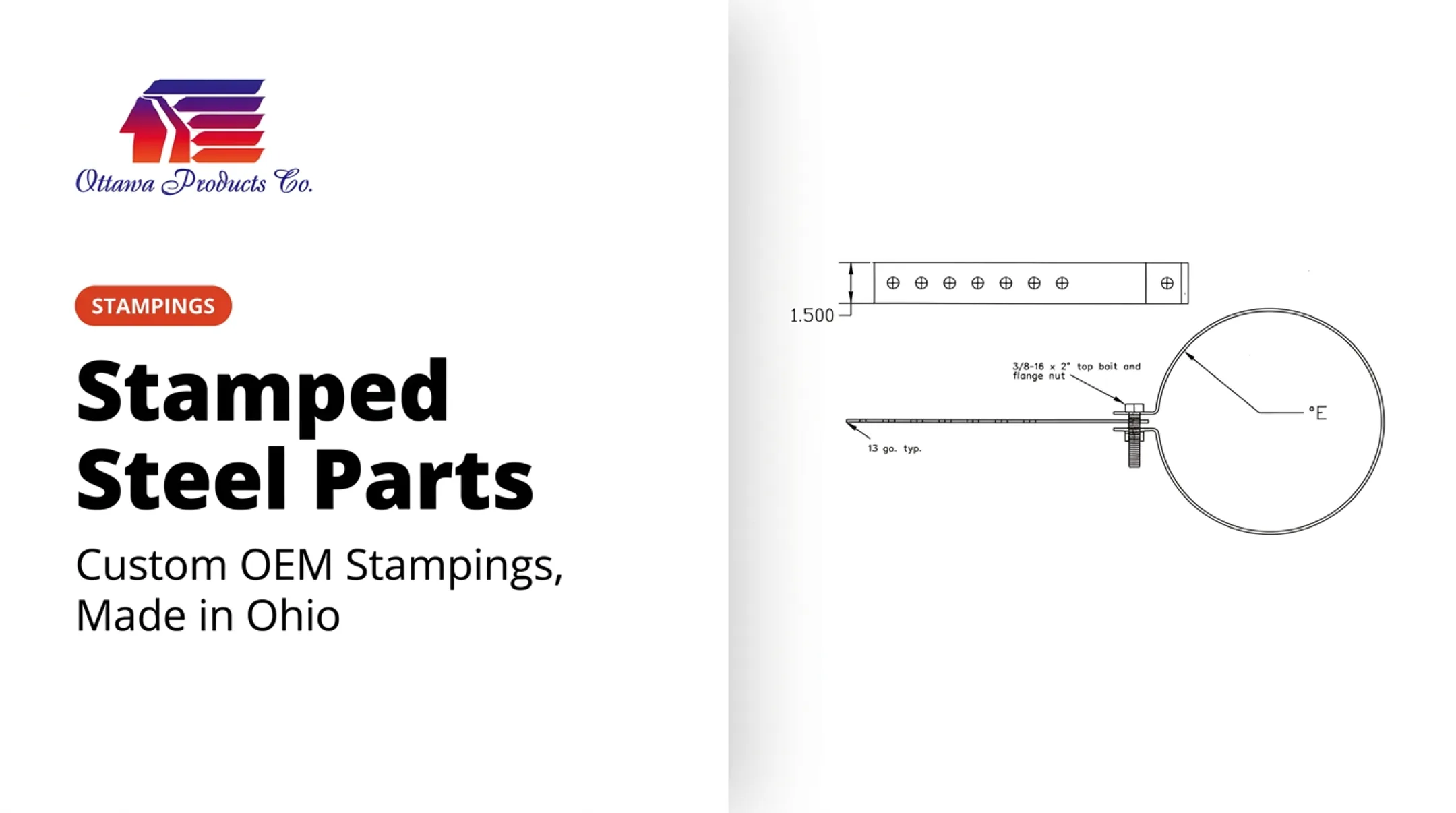
Consider a saddle for a heavy-duty guillotine clamp. Ottawa's GF600 drawing specifies a 6-inch clamp with a C1008 HRPO, 11-gauge saddle and tolerances such as ±1/32 inch. Thickness, material, and tolerance together shape the forming approach, and volume decides how much tooling is worth building.

Benefits, Cost Factors, and Supplier Considerations
Benefits of a Suitable Stamping Process
- Repeatable parts with consistent fit
- Scalable production from low to high volume
- Efficient material use through strip nesting
- Multiple features integrated into one formed part
What Drives a Quote
JV Manufacturing identifies tooling as a major upfront cost. On small runs, setup and inspection costs spread over fewer parts. Other drivers:
- Design complexity and die construction
- Material cost, part size, and thickness
- Tolerances (tight, nonfunctional ones add cost)
- Order volume and setup
- Scrap and material yield
- Deburring, coating, plating, and sorting
- Inspection, packaging, and shipping
Compare total quoted scope, not piece price alone.
Supplier Evaluation Checklist
- Engineering support and manufacturability feedback
- Quality certification and records
- Tooling responsibility
- Sample approval process
- Change control
- Responsive communication
- Lead-time assumptions and capacity
- Support after the quote and into production
Getting Started with a Custom Stamping Supplier
RFQ Checklist
Send as much of this as you have:
- Part drawings and CAD files
- Material, grade, and thickness
- Expected annual and order quantities
- Application environment and performance requirements
- Tolerances and finish
- Packaging and delivery expectations
- Existing samples or legacy tooling
Questions to Ask
- Who holds die title, and who pays for maintenance, replacement, and relocation?
- What happens to unamortized tooling if the program ends early?
- How are design revisions handled?
- What are the sample approval and inspection documentation steps?
- How are nonconformances handled?
- Are there minimum order expectations?
- How does engineering communicate manufacturability concerns?
Die title terms vary by supplier. AAM's terms, for example, give the customer ownership and the supplier upkeep, but that is not an industry default.
Talk to Ottawa Products Co.
Ottawa Products Co. is a U.S. manufacturer in Curtice, Ohio, with an ISO 9001:2015 certified quality system and no minimum order. It makes OEM exhaust clamps, hangers, bent bolts, and related components, and accepts quote requests for custom stampings.

Contact the factory at 419.836.5115 or quotes@ottawaproducts.com to discuss your requirements. Share your drawings and ask what its stamping scope covers for your part.
Frequently Asked Questions
How much does metal stamping cost?
Cost depends on tooling, material, part complexity, tolerances, volume, secondary operations, finishing, inspection, and logistics. Request a project-specific quote.
What is stamping in automotive?
It's the use of presses and dies to cut and form metal into vehicle components. Examples include brackets, retainers, shields, clamps, and hangers.
How is stamping done?
The process starts with design review and die development. Material is then fed into the press, cut or formed, inspected, and approved for production.
What are stamping parts?
They're metal components made by pressing sheet, strip, or blanks through tooling. Automotive examples include brackets, clips, mounts, shields, and clamps.
What is a stamping tool called?
The primary tool is a die. The punch is its male element, the die set holds the opposing members in alignment, and inserts or stations add features.
Who makes stamping dies?
Tool-and-die makers, specialized tooling suppliers, and stampers with in-house or partnered engineering. Confirm who is responsible for design, ownership, maintenance, and revisions.