
Introduction
A nut that threads onto an anchor bolt is not necessarily the right nut. Width across flats, thickness, grade, coating, washer, and projection all have to work together, or the base plate never gets clamped the way the engineer intended.
In the field, the usual failure is quiet: a standard hex nut where the drawing called for heavy hex, a galvanized rod with an undersized nut, or a "3/4-inch bolt" ordered with no pitch.
Virginia inspectors found loose anchor nuts on 30% of inspected cantilever sign structures after two collapses in 2012, according to Virginia's 2020 report. That finding concerns loosening, not nut geometry, but it shows how much depends on installation details.
This article covers the dimensional terms, the U.S. standards, how to read sizes, how to verify them, and what goes wrong when the specification is off.
Key Takeaways
- Heavy hex dimensions describe nut geometry only, not the complete anchor assembly.
- Specify diameter, pitch, thread series, grade, finish, washer, and projection together.
- ASME B18.2.2 governs nut shape; ASTM A563 and F1554 govern material and grade.
- A nut that fits physically can still have the wrong grade, coating, or bearing area.
What Anchor Bolt Dimensions Represent in Heavy Hex Nuts
A heavy hex nut is a six-sided, internally threaded nut that is wider and thicker than a finished hex nut of the same nominal size. ASME B18.2.2 is the U.S. dimensional standard for inch-series nuts. Its current 2022 edition places heavy hex nuts in Table 1.1.1-11 and regular hex nuts in Table 1.1.1-5.
In an anchor assembly, the nut's internal threads engage the rod. Its bearing face transfers clamping force into the base plate, usually through a washer.
Nut Dimensions Versus the Full Dimensional Chain
The nut is one link. A complete anchor specification also covers:
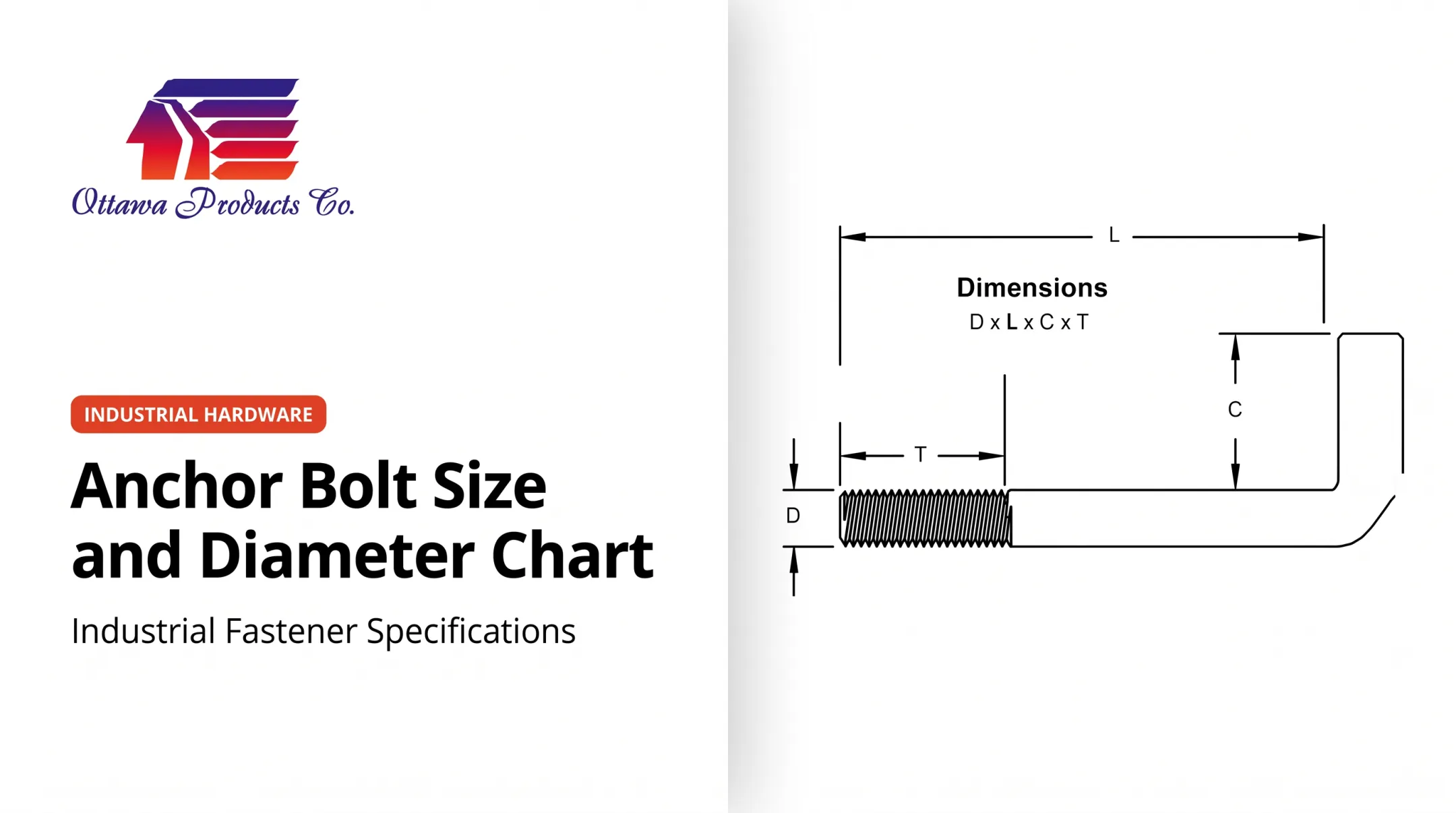
- Nominal diameter and thread pitch
- Threaded length and coated length
- Projection above the base plate
- Embedment depth and overall length
- Bend or hook geometry
- Washer dimensions
- Wrench clearance around the nut
Dimensional Range for Common Anchor Bolt and Heavy Hex Nut Sizes
The table below lists heavy hex nut dimensions for common UNC anchor sizes, with regular hex values for contrast only. All values are in inches, shown as minimum-maximum. Figures follow manufacturer reproductions of ASME B18.2.2 tables; confirm the edition and dimensions against the current standard before ordering.
| Nominal size / UNC | Heavy hex across flats | Heavy hex thickness | Regular hex across flats | Regular hex thickness |
|---|---|---|---|---|
| 1/2-13 | .850-.875 | .464-.504 | .736-.750 | .427-.448 |
| 5/8-11 | 1.031-1.062 | .587-.631 | .922-.938 | .535-.559 |
| 3/4-10 | 1.212-1.250 | .710-.758 | 1.088-1.125 | .617-.665 |
| 7/8-9 | 1.394-1.438 | .833-.885 | 1.269-1.312 | .724-.776 |
| 1-8 | 1.575-1.625 | .956-1.012 | 1.450-1.500 | .831-.887 |
| 1-1/4-7 | 1.938-2.000 | 1.187-1.251 | 1.812-1.875 | 1.030-1.094 |
| 1-1/2-6 | 2.300-2.375 | 1.433-1.505 | 2.175-2.250 | 1.245-1.317 |

Never substitute the regular hex columns for heavy hex. They are different parts.
Washer Pairing
F436 hardened round washers are the default in F1554 unless the purchaser specifies otherwise. For a 3/4 rod, published F436 dimensions are 13/16 in. inside diameter and 1-15/32 in. outside diameter. Oversized base-plate holes call for heavy plate washers, per AISC guidance.
Plain F844 washers are unhardened and are not a substitute for F436.
Factors That Influence Dimensional Fit in Real-World Assemblies
Several things decide whether a nut runs freely and seats flat:
- Thread series and pitch must match exactly
- Thread class 2A on external threads and 2B on internal is a common construction fit
- Galvanizing adds zinc to the rod threads, so mating nuts are tapped oversize
- Damaged or dirty threads bind
- Tight access can prevent a socket from seating
F1554 requires hot-dip galvanized anchors and nuts to follow F2329, and zinc-coated nuts use the same coating process as the rods. The standard also warns that coated 8UN nuts at 1-3/4 in. and larger may not develop full rod strength after overtapping when properties sit near minimum limits.
When project drawings and a general chart disagree, the drawings win. Check the latest standard edition and the engineer-approved assembly specification.
Key Technical Properties of Heavy Hex Nut Dimensions
Five properties separate a suitable nut from one that only looks similar.
Property 1: Width Across Flats and Wrench Clearance
Across-flats width sets the socket or wrench size and the nut's bearing footprint. At 3/4-10, heavy hex runs 1.212-1.250 in., against 1.088-1.125 in. for regular hex. That extra width does not prove extra strength. A socket's outside envelope is larger than the nut, so check clearance against adjacent plates and rods.
Property 2: Thickness, Thread Engagement, and Bearing Area
Thickness governs how many threads engage. Too few risks stripping before the rod yields. Nut thickness is not the same as projection, which is how far the rod extends above the plate.
Bearing interaction matters too. Washer outside diameter, hole size, and plate thickness decide how load spreads under the nut face.
Property 3: Thread Designation and Compatibility
Read "3/4-10 UNC" in three parts:
- 3/4: nominal diameter in inches
- 10: threads per inch
- UNC: Unified National Coarse series
A class such as 2A or 2B is added separately. UNF is the fine series, and 8UN is an alternative that F1554 allows on uncoated anchors over 1 in. when the purchaser specifies it. "3/4-inch" alone is an incomplete description. Never force metric and inch components together.
Property 4: Material Grade and Load Capability
Dimensions say nothing about mechanical suitability. One manufacturer table lists published proof-load stresses for heavy hex nuts:
| A563 nut grade | Proof-load stress |
|---|---|
| A | 100,000 psi |
| C | 144,000 psi |
| DH | 175,000 psi |

F1554 pairs rods and nuts by grade. Grade 105 rod calls for Grade DH heavy hex nuts. Grade 2H, sometimes seen as an alternate, belongs to ASTM A194, not A563. Evaluate nut, rod, and washer as a single assembly.
Property 5: Coating and Dimensional Change
Hot-dip galvanizing changes thread fit, friction, and installation torque. F1554 treats coating process and coated length as ordering items, and requires suitable overtapping for galvanized nuts. Follow F2329 and the product standard for thread requirements instead of assuming coating thickness values.
How Anchor Bolt and Heavy Hex Nut Dimensions Are Specified, Measured, and Validated
Dimensions serve as both a design specification and a receiving check. Drawings, standards, certificates, and physical measurements should all agree.
Specification and Documentation
The documents to work from:
- ASME B18.2.2 for inch nut dimensions
- ASTM F1554 for anchor bolts and rods
- ASTM A563 for carbon and alloy steel nuts
- ASTM F436 or F844 for washers
- ASTM F2329 for hot-dip galvanizing
- Project structural or foundation drawings
A model purchase line follows F1554's ordering information and typically covers:
- Quantity, ASTM designation and year, and grade
- Diameter, pitch, bolt length, and thread length
- Head or hook geometry
- Coating process and coated length
- Nut count, washer count, and dimensions
- Source inspection and required test reports
Grade color codes help at receiving: 36 blue, 55 yellow, 105 red. Supplement S3 allows steel-stamped grade marks instead.
Measurement and Verification Methods
- Use calibrated calipers for across-flats width and nut thickness
- Use GO/NO-GO gages for internal threads, per ASME B1.2 and B1.3
- Check length, projection, bend geometry, and hole alignment against the drawing
The nut should run on by hand through the intended engagement before any wrench is used. Binding, cross-threading, or excessive slop triggers a quality review. Assembling with a mating fastener alone does not prove thread compliance.
Validation Before Installation
- Review material certificates and grade markings
- Confirm proof-load or hardness documentation for nuts separately from rod test reports
- Check coating records and lot identification
- Inspect dimensions against the purchase order

For drawings that include custom bent bolts or related formed components, contact Ottawa Products Co. engineering or quoting for a dimensional and application review. Ottawa manufactures custom bent bolts and anchor and stud bolts from 1/4 to 1/2 inch and is not a supplier of standard heavy hex nuts.
Implications of Using the Wrong Dimensions or Specification
Wrong dimensions show up as field problems:
- Insufficient thread engagement and stripped threads
- A nut that will not install, delaying the pour or erection
- Inadequate bearing and reduced preload
- Loosening over time
Common Specification Errors
- Ordering regular hex when heavy hex is required
- Leaving out thread pitch
- Treating "3/4-inch" as a full designation
- Ignoring galvanized thread allowance
- Assuming a nut that fits has the right grade
The consequences extend to structural safety, failed inspections, warranty disputes, and compliance. For safety-critical anchors, have an engineer or the manufacturer review the assembly.
Common Misinterpretations to Correct
- "Heavy hex means stronger." Strength comes from material, grade, heat treatment, and proof load. Grades A, C, and DH share a shape but not a proof stress.
- "A bigger nut fixes short embedment." It cannot compensate for inadequate embedment, projection, engagement, or base-plate design. AISC notes plug-welding a partially engaged nut is not an effective remedy.
- "Any online chart will do." Generic dimension or torque charts hide the standard, finish, lubrication, and washer assumptions behind them.
Conclusion
Heavy hex nut and anchor bolt dimensions are governing specification details. Confirm them before delivery rather than discovering mismatches later.
Reliable assemblies coordinate dimensions, thread compatibility, grade, coating, washer, inspection, and wrench clearance.
Published tables are a starting point. The applicable standard, the approved drawing, and engineering judgment control the final selection. If your design includes custom bent bolts, Ottawa Products Co., an ISO 9001:2015 certified U.S. manufacturer in Curtice, Ohio, can review the drawing and quote to your requirements, with certifications and PPAP available.
Frequently Asked Questions
What are the dimensions of a 3/4 hex nut?
It depends on style. A 3/4-10 heavy hex nut measures 1.212-1.250 in. across flats and 0.710-0.758 in. thick; a regular hex measures 1.088-1.125 in. and 0.617-0.665 in. Confirm against ASME B18.2.2.
How to read bolt sizes?
In "3/4-10 UNC," 3/4 is nominal diameter, 10 is threads per inch, and UNC is the coarse series. Length, grade, finish, and anchor-specific dimensions must be specified separately.
What is a heavy hex nut used for with anchor bolts?
It is used in structural, foundation, and equipment assemblies where the specified nut style, bearing geometry, and mechanical grade are required.
What standard defines heavy hex nut dimensions?
ASME B18.2.2 is the key U.S. dimensional reference for inch nuts. Confirm the ASTM material grade, coating standard, and project specification separately.
Are heavy hex nuts and regular hex nuts interchangeable on anchor bolts?
Matching threads may let them install, but that does not make them equivalent. Width, thickness, bearing area, grade, and project requirements decide whether substitution is acceptable.
How do you match a heavy hex nut to an anchor bolt?
Match diameter, thread series and pitch, rod grade, nut grade, finish, and washer. Then verify engagement and projection against the approved drawing and standards.