
Buyers usually have the same questions. What exactly is a stamped part? How does stamping compare with casting or machining? What drives cost and quality? And does stamping fit this particular application?
This guide covers tooling, production methods, steel selection, design rules, applications, quality requirements, and how to prepare an RFQ that gets accurate quotes.
Key Takeaways
- Stamped parts are press-formed through blanking, piercing, bending, embossing, and drawing.
- Tooling, material, geometry, volume, tolerances, and finish all shape process choice and total cost.
- Stamping suits repeatable sheet-metal parts; complex solid shapes or low volumes may favor other routes.
- A complete RFQ names the drawing, material, thickness, volume, tolerances, finish, and inspection needs.
What Are Stamped Steel Parts?
Stamped steel parts are components cut and formed from steel sheet, strip, or coil using a press and dedicated tooling. The press supplies the force. The die, a precision tool, does the cutting or forming. Keep the two ideas separate: stamping is the process, and the stamped part is its output.
A part can be a simple flat blank or a formed piece with flanges, ribs, tabs, holes, channels, hems, or shallow drawn features.
Core characteristics of suitable parts
Good stamping candidates follow sheet-metal logic:
- Fairly consistent material thickness
- Defined bend lines and cut features
- Formed surfaces that break down into repeatable press operations
Stiffness often comes from geometry rather than thicker steel. Flanges, beads, ribs, and embossments add rigidity, which helps control weight and material use.
Compared with cast or forged parts, stamped parts begin as flat sheet and suit thin-wall geometry. Casting handles complex three-dimensional shapes, and forging suits relatively simple, high-strength solid shapes. None is universally stronger or cheaper.
Common stamping operations
Stamping in manufacturing is the broader press-based process of cutting and forming sheet metal into parts. FMA's die basics describe these core operations:
| Operation | What it does |
|---|---|
| Blanking | Cuts the outside profile; the cut piece is the part |
| Piercing | Cuts holes or slots; the slug is scrap |
| Bending | Forms metal about a straight axis |
| Flanging | Forms metal about a curved axis |
| Embossing | Stretches sheet into a shallow depression |
| Coining | Squeezes material into shape under high pressure |
| Drawing | Controls metal flow into a cavity to create depth |
Use these terms precisely in drawings and RFQs. Drawing involves material flow, so it isn't interchangeable with bending or stretching.
How Are Stamped Steel Parts Made?
Stamped steel parts are cut and formed in a press using engineered dies. Production typically follows this sequence:

- Review the part design
- Select the material
- Develop the tool and strip layout
- Feed sheet or coil into the press
- Perform the cutting and forming operations
- Complete secondary processes
- Inspect the finished parts
Planning should account for:
- Material utilization and scrap
- Feed direction and part orientation
- Operation order and press capacity
- Access for inspection and maintenance
What is a stamping tool?
A stamping tool is the engineered die assembly that guides and shapes material inside a press. Main components include:
- Punch and die cavity, the working members that cut or form
- Stripper, which holds material down as punches withdraw
- Pilots, which locate the strip in progressive dies
- Guides, which keep upper and lower die halves aligned
Clearance between punch and die matters. It influences burrs, edge rollover, and edge damage. Wear or misalignment makes those problems worse. Advanced high-strength steels need different clearance treatment from lower-strength grades, so there is no universal percentage.
Tooling cost depends on geometry, number of operations, volume, material, tolerances, and tool type.
Common types of steel stamping
According to SME's stamping guide, the main routes are:
- Progressive: coil advances through successive stations while attached to a carrier strip. Suited to repeated production.
- Compound: multiple cutting operations, such as blanking and piercing, in one die and one stroke.
- Transfer: individual blanks move mechanically between stations. Useful when a carrier strip isn't practical.
- Deep drawing: punch, cavity, and blankholder control metal flow into a deep shape. This operation can run inside a multistation route.
For prototypes or short runs, laser cutting plus press-brake bending can avoid dedicated die investment, though unit cost and consistency differ.
Process risks and quality controls
| Risk | Cause | Control |
|---|---|---|
| Springback | Elastic recovery, rising with yield strength | Compensate in tooling |
| Burrs and rough edges | Excess clearance, worn tools, misalignment | Check clearance and tool condition |
| Edge cracking | Cutting damage and work hardening | Inspect edge quality, not burr height alone |
| Wrinkling | Poor control of inward flow in drawing | Blankholder or draw-pad action |
| Thinning or splitting | Formability limits, excessive flow restriction | Balance material flow |
Inspection plans typically combine first-article checks, critical-dimension measurement, material verification, visual and burr inspection, and process monitoring. Ask your supplier for documented capabilities rather than assuming press tonnage, tolerances, or defect rates.
Materials and Design Considerations for Stamped Steel Parts
Choosing the steel
| Category | Notes |
|---|---|
| Cold-rolled low-carbon | Commercial, drawing, deep-drawing, and extra-deep-drawing grades offer progressively more forming capability |
| Hot-rolled pickled and oiled | Drawing grades suit more severe forming; properly prepared pickled steel can be painted |
| HSLA and AHSS | Support strength and weight goals; AHSS needs separate attention to cutting and edge work hardening |
| Galvanized | Zinc-coated sheet for corrosion protection |
| Stainless 304/304L | Ductile when annealed; work hardens fast |
| Stainless 409/439 | Ferritic grades common in exhaust service |
| Aluminized carbon steel | Aluminum-silicon coating for heat and corrosion; used in vehicle exhaust |
Specify the designation, not just "steel." Confirm grade-specific formability, strength, corrosion resistance, weldability, and cost with your mill or supplier.
Environment drives the choice. Moisture, chemicals, road exposure, and exhaust heat all matter. A part in exhaust service may justify aluminized steel or 409/439 stainless, while a bracket in a mild environment may be fine in coated carbon steel.
Cleveland-Cliffs data doesn't establish a universal cost or service-life ranking among these, so validate for your application.
Geometry and design-for-stamping
Thickness, tensile properties, ductility, grain direction, bend radius, and draw depth all affect cracking, wrinkling, thinning, and springback. Your drawing should flag critical dimensions, functional surfaces, hole locations, bend angles, flatness, edge conditions, and required burr direction.

Practical guidelines:
- Use adequate bend radii and bend relief to prevent tearing (SSINA guidance: alloy, strength, thickness, radius, and angle interact; no single ratio applies)
- Keep punched holes away from each other, edges, and bends; tight spacing can distort sheet
- Add corner radii to reduce local fracture
- Use flanges, ribs, beads, hems, and embossments for rigidity and locating, which can avoid thicker stock
- Separate cut-feature tolerances from formed-angle tolerances; sheet variation and rolling stresses often need springback compensation or secondary operations
Finishing and downstream operations
Common secondary steps include:
- Deburring and tumbling
- Tapping, welding, and assembly
- Heat treatment where applicable
- Plating, e-coat, powder coating, and painting
Confirm each step is compatible with your material.
Edge quality matters for coatings. Thermosetting coatings can pull away from sharp edges during cure, leaving thin protection and weaker corrosion performance. Cleanliness, surface preparation, coating thickness, and handling also affect fit, appearance, and service life.
Drawing checklist:
- Material grade and thickness
- Finish and coating
- Critical characteristics
- Inspection method
- Packaging
- Traceability requirements
Benefits, Applications, and Limitations
Advantages
- Repeatable output from dedicated tooling
- Efficient production of sheet-based geometry
- Automation potential
- Efficient material use
- Multiple operations combined in one tooling system
Where stamped steel parts are used
Typical parts include brackets, shields, covers, reinforcement plates, mounting components, clamps, hangers, and industrial hardware. Documented examples include HSLA crossmembers on Class 8 trucks, stamped components for tractors, combines, and tillage equipment, and exhaust parts in aluminized or 409/439 stainless steel.
Limitations
- Upfront tooling investment
- Costly design changes after tooling is cut
- Springback, deep-draw limits, and burr control
- Joining requirements
- Weaker economics for uncertain or very low volumes
Geometry can rule stamping out. In one FMA case, a large cutout left a fragile skeleton that distorted during stamping, so laser cutting and bending suited it better.
Machining fits precision or low-volume work, casting fits complex 3D shapes, and welded fabrication fits assemblies. No universal volume break-even exists, so compare total cost per route.

How to Choose a Stamped Steel Parts Supplier
Evaluate each candidate on:
- Engineering support and tool-design capability
- Press and material range
- Progressive or compound experience
- Secondary operations
- Inspection systems
- Packaging and scheduling
- Support from prototype through repeat orders
RFQ checklist
Include:
- 2D drawings and 3D files (STEP or IGES, flat DXF where applicable)
- Material grade and thickness
- Annual and lot quantities, plus forecast changes
- Critical tolerances
- Hole and bend requirements, burr direction
- Finish, coating, deburring, and welding
- Operating environment
- Inspection documentation
- Delivery expectations
Judging quality evidence
Ask suppliers for:
- Documented inspection procedures
- Material certifications
- First-article or part-approval processes
- Corrective-action practices
- Traceability records
Automotive buyers often request PPAP for production-part approval.
ISO 9001:2015 certifies a quality management system. It does not guarantee product conformity or replace validation of your part. Confirm each supplier's certificate is current and that its scope covers the work you need.
Related OEM components
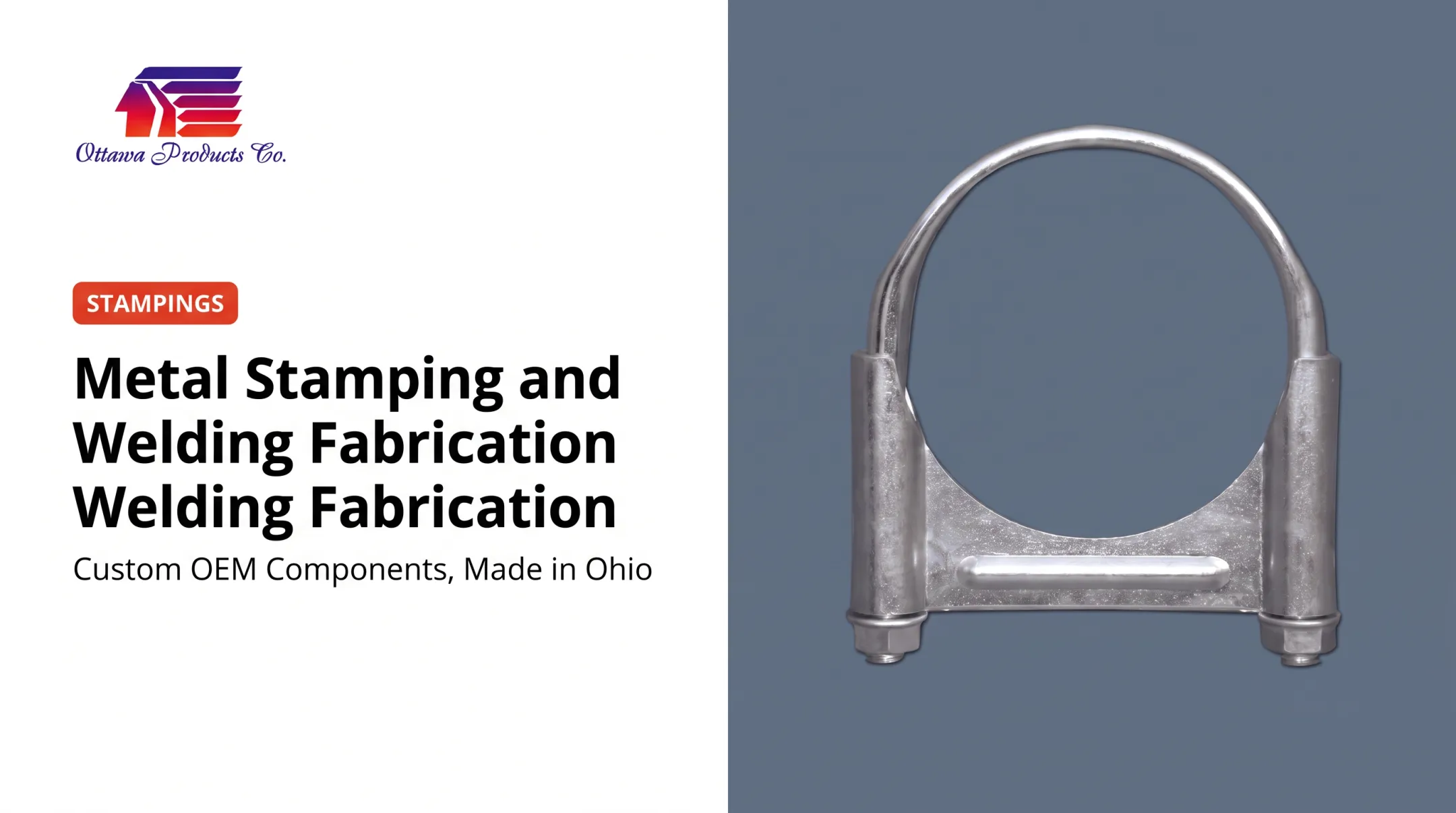
If your project includes exhaust clamps, hangers, bent bolts, or other formed parts, Ottawa Products Co. is a U.S.-based manufacturer in Curtice, Ohio. The company provides quoting and engineering support under an ISO 9001:2015 certified quality management system and can quote custom stampings for price and delivery.
Its certificate scope covers heavy-duty clamps and bent bolts, so confirm stamping specifics during review. Send drawings and requirements to quotes@ottawaproducts.com or engineering@ottawaproducts.com.
Frequently Asked Questions
What is stamping in manufacturing?
A press-based process that cuts and forms sheet or coil metal with a punch and die. Common operations include blanking, piercing, bending, and drawing.
What is a stamping tool?
The die and supporting components used inside a press to control and form material. Punches and die openings cut or shape it, while guides and strippers keep it aligned and held.
What types of steel are used for stamped parts?
Common categories are cold-rolled, hot-rolled pickled, HSLA, galvanized, aluminized, and stainless steel. The right grade depends on formability, strength, corrosion exposure, thickness, finish, and cost.
What are stamped steel parts used for?
Brackets, mounts, shields, covers, reinforcements, clamps, and hangers. They appear in automotive, heavy-duty truck, agricultural, and industrial products.
Are stamped steel parts strong and durable?
It depends on material grade, geometry, bend and edge design, joining, coating, loads, and quality control, not the process alone.
How do I choose a stamped steel parts manufacturer?
Compare engineering and tooling capability, material and volume experience, inspection systems, secondary operations, and quality documentation. Choose one that reviews your full RFQ.